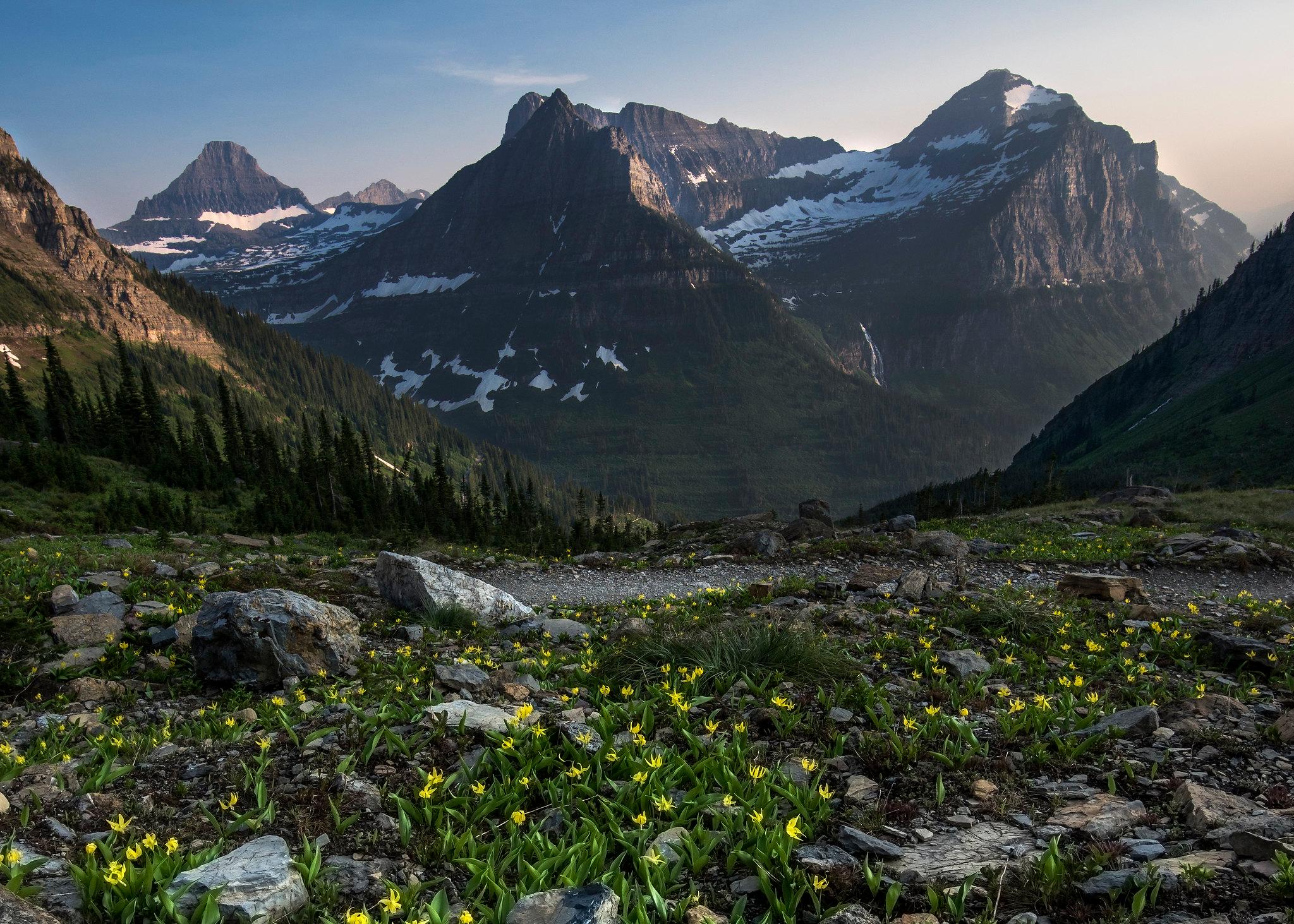
Large mountains dotted with snow loom above a rocky meadow filled with yellow flowers.
GLAC · National Park
MT
Last updated
May 20, 2026

When to visit Glacier.

Glacier's three priorities. Crowd, weather, access. Collide because Going-to-the-Sun's full season is short. The cleanest overall tradeoff is the week after Labor Day through late September: heat eases, larches start turning, the full road traverse is still drivable through the third Monday in October, and visits drop sharply after schools restart. Late June through early July is the next-best window if you can tolerate higher crowds for the longest day length and full operations. November through April, expect Lake McDonald only.

Annual visits3.05M
BusiestJuly
QuietestFebruary
Years on file47
Photo · NPS Photo · NPS source
Annual visits · 5-yr avg3.05M3,136,557 in 2025
Busiest monthJuly761K avg visits
Quietest monthFebruary45× thinner than July
Best tradeoffSeptemberCrowds drop, ops still full
Field note · Glacier
By Nicholas Major Source · NPS + NOAA Updated · May 20, 2026

The best overall window at Glacier is the week after Labor Day through late September; visits drop sharply once schools restart, the full Going-to-the-Sun traverse is still drivable, and larches begin turning gold.

Peak month is July, with a five-year mean of about 761,000 recreation visits. The quietest is February, near 17,000: about 2% of July's peak. Daytime highs at West Glacier (~3,148 ft) reach the mid-60s°F in September.

By mid-September, the school restart drops family travel and weekday traffic eases. The full Going-to-the-Sun Road traverse over Logan Pass stays drivable until the third Monday in October per NPS, and subalpine larches turn gold along the Highline Trail late in the month.

From November through April, only the lower corridor from West Glacier to Lake McDonald Lodge stays plowed; Many Glacier, Two Medicine, and the upper Logan Pass road are closed to vehicles.

Visiting Glacier.

Pick your month.

Three independent signals per month; crowd, weather, and access. Tap any row to read the full Glacier guide for that month. We deliberately do not combine these into a single "best month" number; different priorities point at different months.

Sourced · NPS + NOAA
Each score is 0–100
Green = good for visitor on that axis. Yellow = mixed. Orange/red = avoid for that reason. The word inside each chip is the answer; the line beneath is the data behind it.
Month Crowd Weather Access What that means
January
Empty
2% of peak · 18K visits
Harsh
30°F / 19°F (-1°C / -7°C) · 32.0″ snow
Closed
Composite access score · 15/100
Quietest stretch of the year alongside February. West Entrance and Apgar open; Going-to-the-Sun ends at Lake McDonald Lodge. Cross-country skiing, no shuttles.Read January →
February
Empty
2% of peak · 17K visits
Harsh
34°F / 19°F (1°C / -7°C) · 16.0″ snow
Closed
Composite access score · 15/100
Coldest month at the West Entrance. Lake McDonald frozen at the head. North Fork and Two Medicine roads closed; high country snowcoach-free.Read February →
March
Empty
3% of peak · 26K visits
Harsh
43°F / 25°F (6°C / -4°C) · 14.0″ snow
Closed
Composite access score · 15/100
Snowpack still deep on Logan Pass. Lower GTSR open to Lake McDonald Lodge. Early plowing begins on the upper road. Wildlife stays low.Read March →
April
Empty
6% of peak · 45K visits
Mixed
53°F / 31°F (11°C / 0°C) · 3.1″ snow
Limited
Composite access score · 20/100
Crowds still light. Bears emerging. Apgar and West Glacier services begin opening for the season; upper Going-to-the-Sun closed to vehicles.Read April →
May
Quiet
27% of peak · 202K visits
Ideal
64°F / 39°F (18°C / 4°C) · 0.5″ snow
Partial
Composite access score · 50/100
Visits jump as Many Glacier and Two Medicine roads typically open late May. Going-to-the-Sun above Lake McDonald usually still closed for plowing.Read May →
June
Busy
72% of peak · 551K visits
Ideal
70°F / 45°F (21°C / 7°C) · 3.80″ precip
Full
Composite access score · 85/100
Going-to-the-Sun typically completes plowing late June. Operations ramp toward full. Wildflowers on lower trails; high passes patchy with snow.Read June →
July
Packed
100% of peak · 761K visits
Ideal
80°F / 50°F (27°C / 10°C) · 1.39″ precip
Full
Composite access score · 100/100
Peak month. Logan Pass parking fills before mid-morning. Lake McDonald and Saint Mary briefly swimmable. Afternoon thunderstorms common.Read July →
August
Packed
91% of peak · 693K visits
Ideal
79°F / 48°F (26°C / 9°C) · 1.17″ precip
Full
Composite access score · 100/100
Still near peak. Heat at lower elevations, smoke risk in dry years. Bear activity high on huckleberry trails (NPS bear safety).Read August →
September
Busy
73% of peak · 557K visits
Ideal
68°F / 41°F (20°C / 5°C) · 1.96″ precip
Full
Composite access score · 100/100
Best tradeoff month. Crowds drop sharply after Labor Day. Larches turn gold late month. Lodges start closing mid-to-late September.Read September →
October
Empty
18% of peak · 139K visits
Mixed
52°F / 33°F (11°C / 0°C) · 2.0″ snow
Partial
Composite access score · 50/100
Going-to-the-Sun closes for the season at the third Monday in October. Quiet, often the first reliable snows above 6,000 ft.Read October →
November
Empty
3% of peak · 24K visits
Harsh
37°F / 26°F (3°C / -3°C) · 16.2″ snow
Limited
Composite access score · 30/100
Many Glacier Road closes by the third weekend. Quietest tier of the year. Plowed corridor: West Glacier to Lake McDonald Lodge.Read November →
December
Empty
2% of peak · 19K visits
Harsh
29°F / 20°F (-2°C / -7°C) · 31.4″ snow
Closed
Composite access score · 15/100
Cross-country ski and snowshoe season opens at Apgar. Year-round entrances only; everything else snowed in.Read December →
How these scores are computed (and why there's no combined "best month")

Crowd score

Formula: 100 − (this month's visits ÷ park's peak month visits) × 100. Each park scored against its own peak, not against other parks.

Source: NPS Visitor Use Statistics Data Package 2025, Recreation Visits (TRV), 5-year monthly mean (2021-2025). Reproduce these numbers on the NPS IRMA Stats portal.

Reading it: July at Glacier reads 0 (peak). November reads 97 (nearly empty). A 50 means about half the park's peak crowd.

Weather score

Formula: weatherScore = round(max(0, min(100, dayComfort − precipPenalty − snowPenalty − freezePenalty))). The piecewise day-comfort function is continuous at every boundary.

  • Day comfort: tmax < 50°F → max(10, (tmax − 20) × 2) (cold tail); 50–60°F → 60 + (tmax − 50) × 4 (ramp to 100); 60–78°F → 100 (plateau); 78–85°F → 100 − (tmax − 78) × 5 (ramp to 65); > 85°F → max(30, 65 − (tmax − 85) × 5) (hot tail).
  • Precip penalty: max(0, prcpIn − 1.5) × 8; kicks in above 1.5 in / month.
  • Snow penalty: snowIn × 2.5.
  • Night-freeze penalty: max(0, 32 − tmin) × 1.5 when tmin < 32°F.

Source: NOAA NCEI U.S. Climate Normals 1991-2020, station W Glacier, MT (USC00248809, 3,148 ft).

Caveat: W Glacier sits just outside the park boundary at the West Entrance / park HQ at ~3,148 ft, the same elevation band as Apgar, Lake McDonald Lodge, and the lower Going-to-the-Sun corridor where most visitors lodge and start hikes. The east side of the park (Saint Mary, Many Glacier, Two Medicine) sits at higher elevations and reads colder year-round, especially with the Continental Divide effect. Logan Pass at 6,646 ft routinely sees snow into June and again from September. Treat these numbers as a west-side, valley-floor proxy; high-country trail planning needs an alpine forecast.

Access score

Formula: For each named park road, count it open if its typical operating window covers that month. Score = round((sum of weights of open roads / sum of all weights) x 100). Where a park has a partial winter access mode, the profile documents that assumption in its access notes.

Route weights at Glacier:

  • Going-to-the-Sun Road (full traverse over Logan Pass): Full traverse typically late Jun/early Jul → third Mon in Oct
  • Many Glacier Road: Typically late May → third weekend in November
  • Two Medicine Road: Typically late May → late fall (snow-dependent)
  • Vehicle reservations for Going-to-the-Sun: Year-variable · check NPS Glacier
  • Entry, fees, and timed entry: Year-round entry
  • Lodging: Summer-only · mid-Jun → mid-Sep
  • Wildlife and bear safety: Year-round · peaks summer

Editorial methodology, the route weights themselves are author-curated, sourced from data/processed/operations/road_windows.csv and the park's own access caveats below the score table.

Caveat: The score reflects wheeled-vehicle road access only. Backcountry, hiking, lodging, shuttle, and other service availability are not directly included unless the park profile states otherwise.

Why no combined score?

A combined "best month" number forces a weighting: how much do you care about crowds vs. weather vs. access? Those weights are personal. A photographer optimizing for golden light weights differently than a parent locked to school break weights differently than a winter visitor with a 4WD. We show the inputs and let you decide. Use the per-month grid above to navigate to a deeper page.

For your Glacier trip.

Pick your priority.

Crowd-free trails, full operations, or value-and-solitude. Each card points at a different month; pick the one that fits what you're actually after.

Source · NPS Recreation Visits
5-year monthly mean
If you want

Crowd-free trails

Mid-September → early October

Visits drop noticeably the week schools restart; larches turn gold along the upper Going-to-the-Sun corridor and the Highline Trail in late September. The full Logan Pass traverse typically remains open until the third Monday in October per NPS, confirm the current closing date on the NPS Glacier hours and operating status page. Cool mornings, comfortable mid-elevation days, lodges begin closing mid-to-late month.

Read the Mid-September → early October deep-dive →
If you want

Full operations

Mid-July → late August

Once Going-to-the-Sun completes plowing (typically late June or early July per NPS), every district is reachable and lodges and shuttles run at full schedule. Expect Logan Pass parking to fill before mid-morning. Vehicle reservation rules for Going-to-the-Sun change year to year; check the NPS Glacier conditions page for current entry rules before booking flights.

Read the Mid-July → late August deep-dive →
If you want

Value & solitude

Late October → April

Quietest stretch of the year. Going-to-the-Sun closes for the season at the third Monday in October. Many Glacier Road closes the third weekend in November. The plowed corridor is West Glacier to Lake McDonald Lodge only: about 11 miles inside the park. Cross-country skiing and snowshoeing from Apgar; book lodging in West Glacier, Whitefish, or Kalispell. Watch for icy roads and avalanche-terrain warnings.

Read the winter guide →
For families with kids · June / July / August

Locked to school break?

If summer is your only window, target late July to mid-August once Going-to-the-Sun is reliably fully open, and book lodging 6-12 months ahead.

Glacier's summer problem is a famously short alpine season. Going-to-the-Sun Road across Logan Pass typically does not open in full until late June or early July (NPS). Earlier-summer family trips can find the iconic drive still closed at Logan. The reliable family window is late July through mid-to-late August: every district open, all lodges running, the longest stretch of pleasant weather, and Lake McDonald and Saint Mary briefly swimmable. The constraints to plan around are vehicle-reservation rules (year-variable, on the NPS Glacier page), bear-aware messaging on huckleberry trails (NPS bear safety), and the early-morning parking fight at Logan Pass and Many Glacier. Both fill before mid-morning. The hardest part is lodging: in-park lodges book 6-13 months ahead through Glacier National Park Lodges and Pursuit, and the small inventory at Many Glacier Hotel and Lake McDonald Lodge goes fastest.

1

August

Full Going-to-the-Sun open, every lodge running, warmest swimmable days at Lake McDonald and Saint Mary, late-month school-restart drop pulls crowds below July.
Wildfire smoke risk in dry years (NPS Glacier air quality). Bear activity highest on huckleberry trails. Logan Pass parking still fills before mid-morning early in the month.
2

July

Longest daylight, every district open after the Going-to-the-Sun completion, wildflowers near peak, the only month nearly guaranteed to have the full road traverse driveable from day one.
Absolute peak crowd of the year. Logan Pass and Many Glacier parking gone before mid-morning. Afternoon thunderstorms on high passes; vehicle-reservation rules likely in effect, verify on the NPS Glacier page.
3

June

Waterfalls run hardest, wildlife with cubs/calves active, fewer crowds than July-August. Many Glacier and Two Medicine typically open by late May.
Going-to-the-Sun typically does not finish opening until late June or early July (NPS); earlier-month plans can find Logan Pass still inaccessible. Trails above 6,000 ft still patchy with snow. Mosquitoes intense at lower elevations.
Getting there: airports and ground transport

Closest hub: Glacier Park International (FCA) in Kalispell. ~30 minutes to the West Entrance. Other options: Missoula (MSO) at ~2:30 from West Glacier and Calgary (YYC) at ~3:00 from the Saint Mary / east-side entrance for international travelers entering from Canada. Rental car is effectively required; Amtrak's Empire Builder also stops at West Glacier and East Glacier in summer, which is the rare U.S. national park where rail is a real option for car-free families. Inside the park, NPS runs free shuttles along Going-to-the-Sun in peak season. Check the current shuttle window on the NPS Glacier shuttle page.

Lodging lead time and bases

In-park lodges (Many Glacier Hotel, Lake McDonald Lodge, Rising Sun, Swiftcurrent, Village Inn at Apgar) book 6-13 months ahead through Glacier National Park Lodges and the Pursuit Glacier Park Collection. Many Glacier Hotel sells out fastest. Best family fallbacks: West Glacier for west-side itineraries (closest to Lake McDonald and the Going-to-the-Sun west portal), Whitefish for amenity-heavy west-side base with summer flights, Saint Mary for east-side access to Logan Pass and Many Glacier, East Glacier for Two Medicine and Amtrak access. Avoid Kalispell as a primary base, it adds 30+ minutes each way.

Vehicle reservations

NPS has used a vehicle reservation system on Going-to-the-Sun and the east-side entrances in recent summers. The exact dates, entry windows, lottery cadence, and which entrances require a reservation change year to year. Verify the current rules on the NPS Glacier conditions page before booking flights; a missed reservation can mean turning around at the entrance station.

Bear safety with kids

Glacier is grizzly and black bear country. NPS rules: 100 yards from bears and wolves, 25 yards from all other wildlife. Bear activity peaks on huckleberry trails in late July and August (NPS bear ecology). Carry bear spray on every hike, hike in groups, make noise on blind corners, and store food in vehicles or bear-resistant lockers at trailheads. Review the NPS Glacier bear-safety page before any backcountry day hike.

Wildfire smoke risk

Mid-July through mid-September can carry regional wildfire smoke even when Glacier itself isn't burning. Check AirNow.gov and the NPS Glacier air-quality page for current conditions. August in non-fire years stays clear; in active fire years smoke can shut viewpoints for days and Logan Pass can be closed by nearby fire.

Junior Ranger program

Visitors of all ages can earn a Junior Ranger badge at the Apgar, Saint Mary, or Logan Pass visitor centers; activities scale with age. Booklet is a small fee: confirm the current price at the desk on arrival. Takes 2-4 hours of in-park activities and is the highest-ROI kid experience at Glacier outside the Going-to-the-Sun drive itself.

Logan Pass and Many Glacier parking

NPS warns that Logan Pass and Many Glacier parking fills before mid-morning on summer days. The free Going-to-the-Sun shuttle is the practical solution. Board at Apgar, Avalanche Creek, or Saint Mary and skip the parking fight. Confirm the current shuttle window on the NPS Glacier shuttle page.

For photographers · flexible calendar

The light, the window.

Glacier's best light is dawn on the east side (Saint Mary, Many Glacier) and the late September larch turn on the Highline.

Glacier rewards photographers who anchor a trip to alpine light, larch color, and water: not to convenience. The east side (Saint Mary Lake, Wild Goose Island, Many Glacier) takes first light against west-facing peaks; the west side (Lake McDonald) takes last light against east-facing ranges. Logan Pass and the Highline Trail along the Garden Wall give the iconic alpine wildflower compositions in July and the gold-larch ridgelines in late September into early October. Lake McDonald's red and green pebbles photograph best at low water in late summer. The Going-to-the-Sun season is the operational constraint: the road typically closes for the year on the third Monday in October per NPS, so any October trip should target the first half of the month. Glacier is also a certified International Dark Sky Park. Apgar, Logan Pass, and Saint Mary are the practical dark-sky stops, weather permitting.

Sunrise & sunset at the cardinal dates

DateSunriseSunset
March 21 (vernal equinox)7:43 AM7:54 PM
June 21 (summer solstice)5:39 AM9:48 PM
September 21 (autumnal equinox)7:18 AM7:32 PM
December 21 (winter solstice)8:31 AM4:48 PM
Times at West Glacier, MT (48.50°N, 113.98°W). Source: U.S. Naval Observatory Rise/Set/Transit/Twilight Data. Mountain Time (MDT March-November; MST December-February). East-side locations (Saint Mary, Many Glacier) read 1-3 minutes earlier; high passes block direct light for 30-60 minutes after listed sunrise inside steep valleys.
Saint Mary Lake / Wild Goose Island sunrise
Late May → mid-October (Going-to-the-Sun open)

Pull out at the Wild Goose Island overlook on the east side of Going-to-the-Sun and be set up 15 minutes before listed sunrise. The east-facing peaks behind the island light up first.

Lake McDonald pebble shore at low water
Late August → early October

Lake levels drop, exposing the multi-colored pebble shoreline. Best on still mornings before the wind picks up. Closer to lake-edge lodges than any other Glacier composition.

Highline Trail / Garden Wall larch turn
Mid-September → early October

Subalpine larches turn gold along the Garden Wall and the upper Highline Trail. Plan around the Going-to-the-Sun closing date (third Monday in October per NPS). Confirm on the NPS Glacier hours page.

Many Glacier dawn, Grinnell Point reflection
Late May → mid-October (Many Glacier Road open)

Swiftcurrent Lake at the Many Glacier Hotel boat dock reflects Grinnell Point in still pre-dawn light. Construction/temporary closures have affected this district in recent years; confirm access on the NPS Glacier conditions page.

Dark sky / Milky Way at Apgar and Logan Pass
Late June → early October new-moon windows

Glacier is an International Dark Sky Park. Apgar's lakeshore at Lake McDonald and Logan Pass on clear nights are the practical stops. Avoid full-moon weeks.

Air quality & smoke check: NPS Glacier air quality

Glacier crowds, by month.

Average recreation visits at Glacier National Park, calendar order. Each bar is normalised to the park's peak month; taller bar, busier month. Tap a row to read the park-month page.

Statistic · TRV
Window · 5 years
Month Crowd vs peak month Avg visits (5-yr) % of peak Band What's actually happening
JanuaryJan
17,992↓ 17,984 latest 2/ 100 Lowest Quietest stretch of the year alongside February. West Entrance and Apgar open; Going-to-the-Sun ends at Lake McDonald Lodge. Cross-country skiing, no shuttles.
FebruaryFeb
16,922↓ 15,202 latest 2/ 100 Lowest Coldest month at the West Entrance. Lake McDonald frozen at the head. North Fork and Two Medicine roads closed; high country snowcoach-free.
MarchMar
25,800↑ 25,909 latest 3/ 100 Lowest Snowpack still deep on Logan Pass. Lower GTSR open to Lake McDonald Lodge. Early plowing begins on the upper road. Wildlife stays low.
AprilApr
45,417↑ 48,576 latest 6/ 100 Lowest Crowds still light. Bears emerging. Apgar and West Glacier services begin opening for the season; upper Going-to-the-Sun closed to vehicles.
MayMay
202,281↑ 238,766 latest 27/ 100 Low Visits jump as Many Glacier and Two Medicine roads typically open late May. Going-to-the-Sun above Lake McDonald usually still closed for plowing.
JuneJun
551,415↑ 576,577 latest 72/ 100 High Going-to-the-Sun typically completes plowing late June. Operations ramp toward full. Wildflowers on lower trails; high passes patchy with snow.
JulyJul
761,346↑ 765,061 latest 100/ 100 Peak Peak month. Logan Pass parking fills before mid-morning. Lake McDonald and Saint Mary briefly swimmable. Afternoon thunderstorms common.
AugustAug
693,318↑ 718,766 latest 91/ 100 Peak Still near peak. Heat at lower elevations, smoke risk in dry years. Bear activity high on huckleberry trails (NPS bear safety).
SeptemberSep
557,269↓ 552,479 latest 73/ 100 High Best tradeoff month. Crowds drop sharply after Labor Day. Larches turn gold late month. Lodges start closing mid-to-late September.
OctoberOct
139,359↓ 127,537 latest 18/ 100 Low Going-to-the-Sun closes for the season at the third Monday in October. Quiet, often the first reliable snows above 6,000 ft.
NovemberNov
24,006↑ 27,967 latest 3/ 100 Lowest Many Glacier Road closes by the third weekend. Quietest tier of the year. Plowed corridor: West Glacier to Lake McDonald Lodge.
DecemberDec
18,684↑ 21,733 latest 2/ 100 Lowest Cross-country ski and snowshoe season opens at Apgar. Year-round entrances only; everything else snowed in.
September caveat

Glacier's September monthly mean (~73% of July's peak) blends a busy first half. Labor Day weekend, full Going-to-the-Sun, larches not yet turned. With a quieter second half once schools restart and larches peak. We don't yet publish weekly NPS counts on this page; when we do, the September curve will show the late-month drop explicitly. Treat the headline 'best week' recommendation as observational, not yet chart-backed at weekly resolution.

Glacier weather, by month.

NOAA climate normals 1991-2020 for the station closest to park headquarters. Use it as a planning floor, not a forecast, and read the elevation caveat below.

NOAA NCEI · 1991-2020
Station · W Glacier, MT
Month Temperature range (°F) High Low Precip (in) Snow (in) Verdict
January
30°°F high 19°°F low 3.54inches 32.0inches Harsh cold
February
34°°F high 19°°F low 2.17inches 16.0inches Harsh cold
March
43°°F high 25°°F low 2.58inches 14.0inches Cold
April
53°°F high 31°°F low 2.15inches 3.1inches Cold
May
64°°F high 39°°F low 2.62inches 0.5inches Shoulder
June
70°°F high 45°°F low 3.80inches 0.0inches Warm
July
80°°F high 50°°F low 1.39inches 0.0inches Hot
August
79°°F high 48°°F low 1.17inches 0.0inches Warm
September
68°°F high 41°°F low 1.96inches 0.0inches Warm
October
52°°F high 33°°F low 3.05inches 2.0inches Cold
November
37°°F high 26°°F low 3.23inches 16.2inches Harsh cold
December
29°°F high 20°°F low 3.21inches 31.4inches Harsh cold
Source: NOAA NCEI U.S. Climate Normals 1991-2020 · station W Glacier, MT (USC00248809, 3,148 ft).
Elevation caveat: W Glacier sits just outside the park boundary at the West Entrance / park HQ at ~3,148 ft, the same elevation band as Apgar, Lake McDonald Lodge, and the lower Going-to-the-Sun corridor where most visitors lodge and start hikes. The east side of the park (Saint Mary, Many Glacier, Two Medicine) sits at higher elevations and reads colder year-round, especially with the Continental Divide effect. Logan Pass at 6,646 ft routinely sees snow into June and again from September. Treat these numbers as a west-side, valley-floor proxy; high-country trail planning needs an alpine forecast.
Preview · pending pipeline verification

Year over year.

Annual recreation visits at Glacier National Park, 2015–2025. Hover any bar to compare; the chart is the same record the agency itself publishes.

Source · NPS IRMA Stats
Statistic · Recreation Visits
2.37M
2.95M
3.31M
2.97M
3.05M
1.70M*
3.08M
2.91M
2.93M
3.21M
3.14M
2015
2016
2017All-time record
2018
2019
2020Reduced ops · pandemic · late opening
2021Ticketed-entry pilot
2022
2023
2024
2025
*Affected by COVID-19 closures and reduced operations.
Latest annual3,136,557
5-year mean3,053,808
11-year record high3,305,512 in 2017

Access & operations.

Roads, lodges, entrances. The seasonal pattern that turns a good plan on paper into a workable one in the field. Verify with NPS before you travel; these change.

Independent summary
Last updated · May 20, 2026
Full traverse typically late Jun/early Jul → third Mon in Oct

Going-to-the-Sun Road (full traverse over Logan Pass)

The 50-mile signature drive across the Continental Divide. Per NPS, the entire road does not usually open until late June or early July and remains fully open until the third Monday in October, conditions permitting. The lower section from West Glacier to Lake McDonald Lodge is plowed and open year-round, but the road above Lake McDonald to Logan Pass and east to Saint Mary is closed to vehicles in winter and spring. Verify the current opening and closing dates on the NPS Glacier hours and operating status page before scheduling a trip around Logan Pass.

Typically late May → third weekend in November

Many Glacier Road

The 12-mile road into the Many Glacier district, the east-side hub for Grinnell Glacier, Iceberg Lake, and Swiftcurrent Lake. Per NPS the road closes the third weekend in November, weather permitting, and typically opens in late May. Many Glacier construction or temporary closures have affected this corridor in recent years. Confirm current vehicle access and any in-progress road work on the NPS Glacier conditions page before counting on this district.

Typically late May → late fall (snow-dependent)

Two Medicine Road

Quieter southeast-side district reached via US-2 and MT-49. Per NPS the road closes for the season once inclement weather and snow accumulation require it. Open access typically starts in late May. Two Medicine has a campground, a small store at the lake, and trailheads for Scenic Point and Dawson-Pitamakan. Verify current opening and closing on the NPS Glacier hours page.

Year-variable · check NPS Glacier

Vehicle reservations for Going-to-the-Sun

NPS has used a vehicle reservation system on Going-to-the-Sun in recent peak seasons. Rules, dates, and fees change year to year. For any summer trip, verify the current vehicle-reservation rules and the windows for the West Entrance, Saint Mary, and Many Glacier on the NPS Glacier conditions page well before booking flights or lodging.

Year-round entry

Entry, fees, and timed entry

The standard 7-day vehicle pass is set by NPS and is per vehicle, not per person. Verify current rates on the NPS Glacier fees page. The America the Beautiful Annual Pass covers entry to all U.S. national parks; the Senior Pass covers U.S. citizens 62+. A vehicle reservation, if in effect that summer, is separate from the entry fee.

Summer-only · mid-Jun → mid-Sep

Lodging

Most in-park lodges (Many Glacier Hotel, Lake McDonald Lodge, Rising Sun, Swiftcurrent, Village Inn at Apgar) run a short summer season, typically mid-June to mid-September depending on the property; and book months ahead through Glacier National Park Lodges and Pursuit's Glacier Park Collection. Apgar Village campgrounds and outside-the-park bases (West Glacier, Whitefish, Kalispell, Saint Mary, Browning, East Glacier) are the practical fallbacks. There are no winter in-park hotels.

Year-round · peaks summer

Wildlife and bear safety

Glacier is grizzly and black bear country. NPS asks visitors to carry bear spray, stay 100 yards from bears and wolves, and 25 yards from all other large wildlife. Bear activity spikes on huckleberry trails in late summer (NPS bear ecology). Review the NPS Glacier bear-safety page before any backcountry hike.

For families with kids · year-round

Junior Ranger.

Glacier's Junior Ranger program lets kids work through an age-tiered activity booklet, get sworn in by a ranger, and earn a wooden badge. Confirm the current booklet fee at the desk on arrival; a fillable PDF is also available on the NPS Glacier site. The program scales, younger kids draw and observe, older kids write and identify, and the chapter on alpine geology and the Continental Divide gives older kids a real science angle. Glacier is in the International Peace Park with Waterton Lakes (Canada), and the NPS-Parks Canada cooperative program is acknowledged in the booklet; a thoughtful add to a road trip that includes Waterton.

Glacier Junior Ranger. Apgar, Saint Mary, and Logan Pass visitor centers.
Age tiers
  • All ages: Booklet activities are designed to scale with adult help; pre-readers focus on observation and drawing, older kids do writing and identification.
  • Pre-readers: Parents read prompts aloud and help with the trail and visitor-center exhibit activities.
  • Older kids and teens: Continental Divide geology, glacial ecology, and Peace Park activities. Big-picture science angles around alpine ecosystems and climate.
CostConfirm the current Glacier Junior Ranger booklet price at the visitor-center desk on arrival; a fillable PDF is also available on the NPS Glacier site.
Where to get itApgar Visitor Center (west side, near Lake McDonald), Saint Mary Visitor Center (east entrance), and Logan Pass Visitor Center (when open, typically late June through mid-September).
Time to complete2-4 hours of in-park activities; can be done across multiple days.
Badge ceremonyReturn the completed booklet to a visitor center for the swearing-in and wooden badge. Like other NPS units, you must be in the park to receive the badge.
For RV travelers · length matters

RV & big-rig.

Going-to-the-Sun has a hard size cap (21 ft long, 8 ft wide including mirrors per NPS); base outside the park or use a tow-vehicle.

Glacier is the most RV-constrained mainstream park because of one road. Per NPS, vehicle and vehicle combinations longer than 21 feet (including bumpers) and wider than 8 feet (including mirrors) are prohibited between Avalanche Campground and Sun Point on Going-to-the-Sun. Tall rigs over 10 feet are also restricted at the Logan Pass tunnel. This effectively means most modern RVs and many tow setups cannot drive the signature road and must use the free Going-to-the-Sun shuttle from Apgar, Avalanche, or Saint Mary, or drop the rig in a campground and use a separate small vehicle. Verify the current dimensions on the NPS Glacier vehicle size limits page before any RV trip. For lodging: there are no full-hookup NPS campgrounds inside Glacier. The closest in-park RV options are Apgar Campground (some long-rig sites, no hookups), Saint Mary Campground (no hookups), and Many Glacier Campground (length limits, no hookups). Full-hookup RV parks are outside the park in West Glacier, Hungry Horse, Whitefish, and East Glacier.

RV length limits by road

Where your rig fits (and doesn't)

  • Going-to-the-Sun Road (Avalanche → Sun Point)Max 21 ft; Per NPS, vehicles and combinations longer than 21 ft (including bumpers) and wider than 8 ft (including mirrors) are prohibited. Tall rigs over 10 ft restricted at Logan Pass. Confirm current dimensions on the NPS vehicle size limits page.
  • Going-to-the-Sun (West Glacier → Lake McDonald Lodge)Advisory; Plowed and open year-round, no NPS dimension cap on this lower section. RVs can reach Apgar, Lake McDonald Lodge, and Avalanche Campground without hitting the 21-ft restriction.
  • Many Glacier RoadAdvisory; Open typically late May to third weekend in November. Narrow with frost heaves; advisory for rigs over ~30 ft. Construction has affected access in recent years: confirm on the NPS Glacier conditions page.
  • Two Medicine RoadAdvisory; Open typically late May to late fall. Narrow with tight switchbacks at the lake. Advisory for rigs over ~30 ft.
In-park hookups

Full hookups inside the park

None. Glacier has no full-hookup campgrounds inside the park. Apgar Campground has some longer sites without hookups, Saint Mary Campground accepts RVs without hookups, and Many Glacier Campground accepts smaller rigs without hookups. Reservable through Recreation.gov.

Dump stations

Where to dump tanks

Inside the park: Apgar, Saint Mary, and Fish Creek campgrounds have dump stations during the operating season (typically late May to mid-September). Outside the park: full-hookup RV parks in West Glacier, Hungry Horse, Whitefish, and East Glacier offer dump service to non-guests for a fee. Call ahead.

Outside-the-park

Nearby RV parks

Leave the rig parked

Reaching signature sights without the RV

Park the rig at Apgar Campground or a private RV park near West Glacier and use the free NPS Going-to-the-Sun shuttle (typically runs early July through Labor Day, peak Going-to-the-Sun shuttle window, confirm on the NPS Glacier shuttle page) to reach Logan Pass and the iconic stops. For the east side and Many Glacier, the shuttle does not run continuously over the divide, so a separate small vehicle (toad or rental) is the practical option for full-park RV trips.

Visiting in winter · November → April

Driving in winter?

In winter, the only road open inside the park is West Glacier → Lake McDonald Lodge.

From late October through April, the only road inside Glacier open to wheeled vehicles is the lower Going-to-the-Sun corridor from the West Entrance through Apgar Village to Lake McDonald Lodge; about 11 miles inside the park. It is plowed year-round, weather permitting. Many Glacier, Two Medicine, and the upper Going-to-the-Sun road over Logan Pass are closed to vehicles. This corridor is enough to ski, snowshoe, photograph Lake McDonald in winter, and stay at the (closed in winter) lodge area, but is not enough for any high-country sightseeing.

Access mode

What moves in winter

Not applicable. Glacier does not run a snowcoach or commercial snowmobile system into the interior the way Yellowstone does. Winter access beyond the West Entrance corridor is foot-, ski-, or snowshoe-powered. Avalanche danger is real on backcountry routes: check the Flathead Avalanche Center forecast before any backcountry day.

Season / status check

Confirm before the drive

Not applicable.

Your vehicle

Road-ready plan

The West Glacier-to-Lake McDonald corridor is plowed but stays icy in shaded sections, especially around Apgar's lakeshore. AWD or 4WD with proper snow tires is strongly recommended. US-2 (the south boundary highway around to East Glacier) is the main winter through-route and is plowed year-round but can close for storms or avalanche control at Marias Pass.

Lodging

Where the trip anchors

No in-park lodges operate in winter at Glacier. Lake McDonald Lodge, Many Glacier Hotel, Rising Sun, and Apgar Village close by mid-October. Winter trips base in West Glacier (motels and cabins), Whitefish (full amenity town ~25 minutes west), Kalispell (largest town nearby, ~45 minutes), or Saint Mary / East Glacier on the east side (limited winter options). Confirm seasonal status of any specific property before booking.

Where to base

Gateway towns

Best winter bases: West Glacier (closest to the plowed corridor, basic services year-round) or Whitefish, MT (full amenities, ski resort, ~25 minutes from the West Entrance). Kalispell is the largest town and the airport hub; East Glacier is open but quieter and the upper road to Saint Mary may be intermittently closed by avalanche control on US-2.

How this page
is built.

Independent, reader-supported.
Not affiliated with or endorsed
by the National Park Service.

Crowd numbers on this page are the Recreation Visits column from the NPS Visitor Use Statistics Data Package, 2025. Monthly figures are five-year arithmetic means (2021-2025) against each park's own peak month. We do not compare parks against each other for the crowd score: only against themselves.

Weather numbers are NOAA NCEI U.S. Climate Normals 1991-2020, drawn from the W Glacier, MT station (USC00248809). The station sits at 3,148 ft; the elevation caveat above the weather table explains where this misreads the higher districts.

Access notes are an independent summary of NPS operating posture. We do not republish NPS pages; we link them. Conditions change; confirm road status, reservation requirements, and lodging windows on https://www.nps.gov/glac/index.htm before travel.

Crowd sourceNPS Visitor Use Statistics Data Package
Crowd range1979-2025
Weather sourceNOAA NCEI Normals
Weather period1991-2020
Last-mile check
The Almanac Mailing

The next Glacier
window, in your inbox.

One email a month. The park to point at, the week to book, the trail that's about to fill up. Unsubscribe in a click.

One email per month. We file your address with care.