Per-month · June

Glacier in June.

June serves visitors who want pre-monsoon stability and the longest daylight of the year, with the caveat that the iconic full Going-to-the-Sun traverse is not reliably open until late month.

By Nicholas Major · Last updated

June is the start of high-season at Glacier. The five-year mean is about 551,000 recreation visits — about 72% of the summer peak — driven by the rapid ramp toward the eventual Going-to-the-Sun full opening. The Logan Pass section typically completes plowing in late June or early July per NPS, so much of the month still has the upper road closed to vehicles. Many Glacier and Two Medicine are at full operation. The W Glacier observer logs a June high near 70°F with overnight lows near 45°F and a precipitation reading of 3.80 inches — the year's wettest at the gateway, delivered as a mix of steady cover and afternoon thunderstorms in the high country. Wildflowers explode in the subalpine meadows in the back half. Vehicle reservation rules are year-variable — confirm on the official NPS Glacier conditions page before any trip that hinges on the full traverse.

Crowd snapshot.

June runs about 551,000 recreation visits in the five-year mean — about 72% of July's peak and well into Glacier's heavy-traffic band by mid-month. Many Glacier and Two Medicine campgrounds see their first sustained sold-out weekends, and Logan Pass parking pressure begins once the road traverse completes. West Glacier and Whitefish lodging tighten across weekends and steady through midweek. The free Going-to-the-Sun shuttle typically begins running once the full traverse opens. In-park lodges hit full operation through the month; Many Glacier Hotel and Lake McDonald Lodge are widely sold out across the back half of June.

FieldValue
June recreation visits (5-yr mean)551,415
Share of July's peak72%
Crowd bandhigh
Park's busiest month (5-yr mean)July
Park's quietest month (5-yr mean)February

Weather snapshot.

The W Glacier NOAA station records a June high near 70.4°F and a low near 45.1°F. The monthly precipitation normal of 3.80 inches is the year's highest reading at the cooperative observer, delivered as a mix of long-duration cover from Pacific frontal systems early-month and growing afternoon thunderstorm activity on the upper road and east-side ridges in the back half. Snowfall ends at the cooperative elevation by month-start; high country above 6,000 ft can still see late-June flurries. Days are the year's longest, with usable photography light extending past 9:30 p.m. local time. Mosquitoes intensify at lower-elevation riparian zones and around Two Medicine Lake.

FieldValue
Average high (°F)70.4
Average low (°F)45.1
Precipitation (inches)3.80
Snowfall (inches)0.0
Weather bandwarm
StationW Glacier, MT at 3,148 ft

Access snapshot.

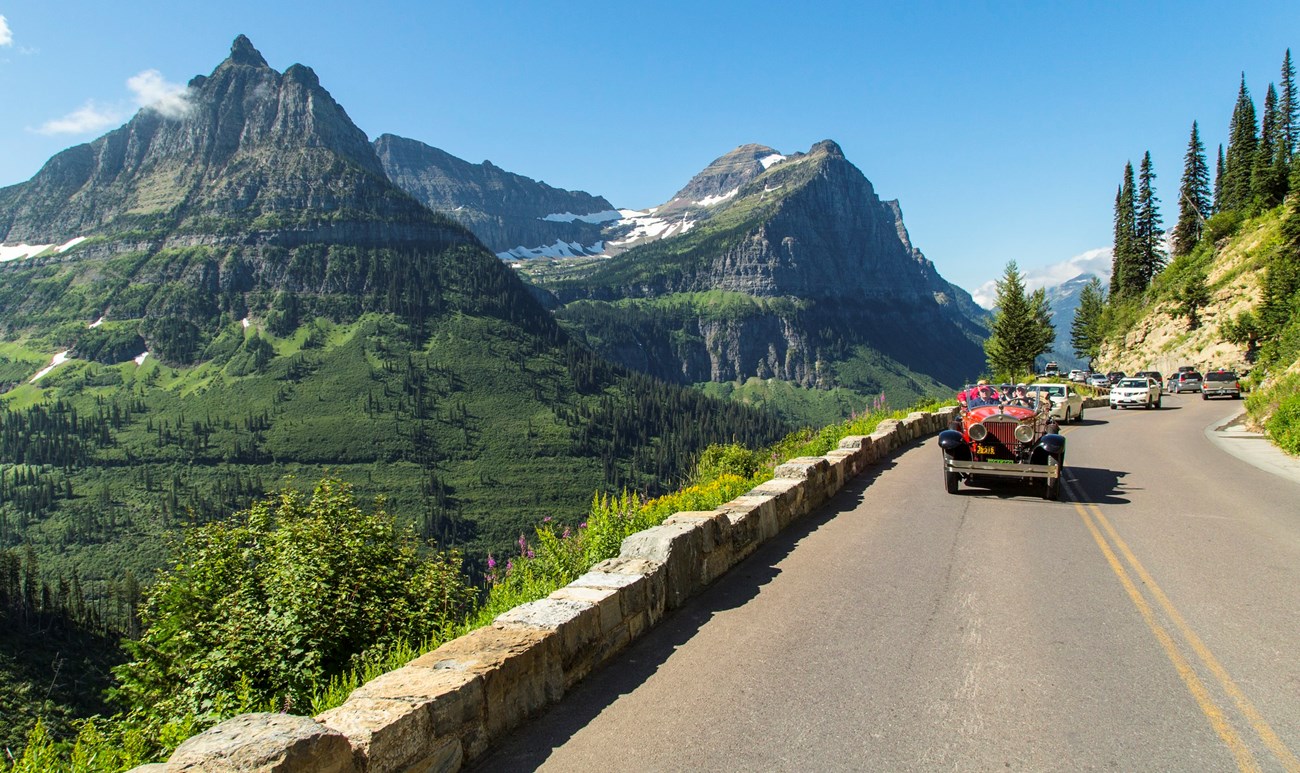
Going-to-the-Sun Road typically completes plowing across the divide in late June or early July per NPS Glacier hours — verify the current opening date. Many Glacier and Two Medicine roads run full schedule. Vehicle reservation rules are year-variable and the dedicated NPS reservation page is currently being updated; verify current entry rules on the NPS Glacier conditions page before booking. The summer $35 vehicle pass applies via the NPS fees page. In-park lodges are at full schedule via Glacier National Park Lodges and Pursuit. Bear-aware messaging applies across all backcountry trails — review the NPS bear-safety page.

FieldValue
June access score (0-100)85
Year-round routeLower Going-to-the-Sun Road from West Glacier through Apgar to Lake McDonald Lodge (Going-to-the-Sun upper section closed ~mid-October through late June; Many Glacier and Two Medicine closed ~third weekend November through late May)
Verify current road and reservation statusOfficial NPS Glacier conditions page

Seasonal events.

June is wildflower-build month across the subalpine and lower meadows. Glacier lily, paintbrush, arrowleaf balsamroot, beargrass, and lupine emerge in waves through the month, with peak in the lower meadows in the second half. Mountain goat kids appear along the cliffs above Going-to-the-Sun's lower section (NPS Glacier wildlife). Hoary marmots and Columbian ground squirrels are reliably active at every lower-elevation pullout. Bald eagle pairs feed chicks along McDonald Creek and the Middle Fork. Waterfalls run at peak snowmelt flow — McDonald Falls, Avalanche Creek, Sun Point Nature Trail's falls, Running Eagle Falls in Two Medicine, and Saint Mary Falls all carry their strongest annual flow. Bear activity is high throughout the meadows and on south-facing slopes (NPS Glacier bear ecology).

Audience verdict.

June serves visitors who want pre-monsoon stability and the longest daylight of the year, with the caveat that the iconic full Going-to-the-Sun traverse is not reliably open until late month. Photographers gain peak-snowmelt waterfalls and emerging wildflower foregrounds against snow-capped peaks. Families locked to early-summer school breaks should book lodging months ahead, confirm the current vehicle-reservation rules, and plan around the fact that Logan Pass may not be accessible by vehicle in the first half. RV travelers benefit from full Many Glacier and Two Medicine campground operations, no in-park hookups. Anyone optimizing for solitude should wait for September; the late-June-through-Labor-Day window is now firmly peak.

Methodology

Monthly recreation visits come from the official NPS Visitor Use Statistics Data Package, 2025 on NPS IRMA Stats; the statistic shown is Recreation Visits, the 5-year mean across 1979-2025. Climate normals come from NOAA NCEI's 1991-2020 U.S. Climate Normals at W Glacier, MT (station USC00248809, 3,148 ft elevation). The access score weights named park roads by route importance for typical wheeled-vehicle openings that month. Year-variable specifics — exact Going-to-the-Sun Road open/close dates, Many Glacier and Two Medicine Road dates, vehicle-reservation rules — drift year to year and are hedged in the editorial above; confirm current dates on the official NPS Glacier page before booking. Independent site, not affiliated with the National Park Service.

Independence

Independent site. Not affiliated with or endorsed by the National Park Service. Data comes from the official NPS Visitor Use Statistics Data Package, 2025; editorial analysis is ours. The NPS Arrowhead and other NPS marks are not used.

Last updated · 2026-05-20