Per-month · March

Glacier in March.

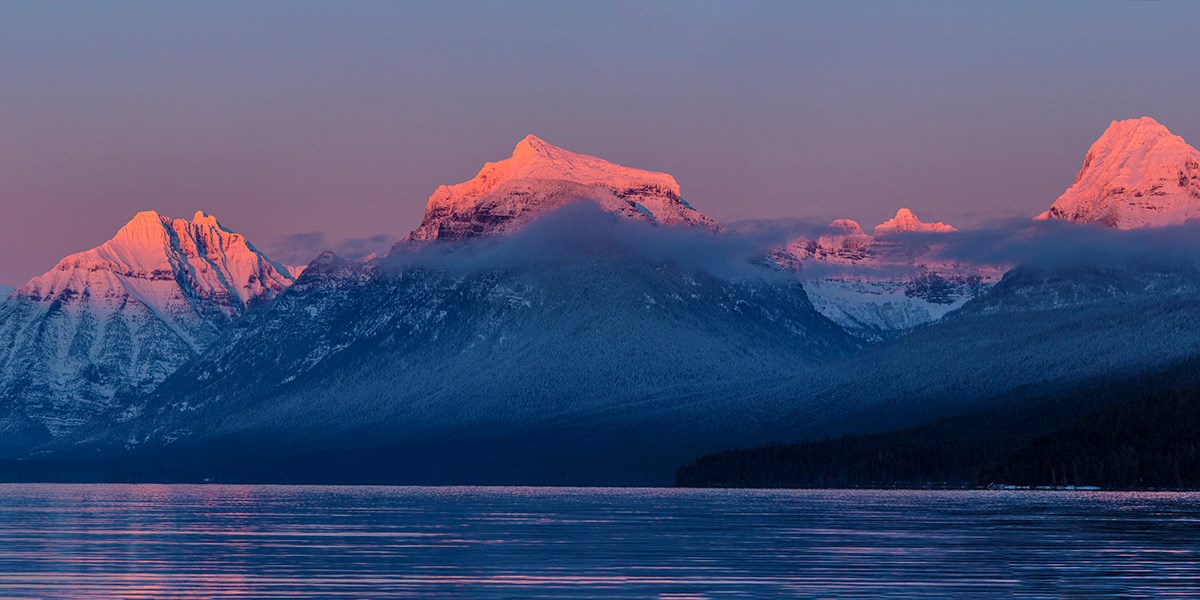
March suits visitors who want winter-recreation conditions with the season's longest light: cross-country skiers and snowshoers on the McDonald corridor and the still-closed upper road, late-winter photographers chasing low side-light, and Flathead Valley day-trippers who can build a short Whitefish or West Glacier weekend around it.

By Nicholas Major · Last updated

March is still a winter month at Glacier in operational terms — but it carries the first signal of the coming season. The five-year mean climbs to about 26,000 recreation visits, still small but a noticeable lift off the deep winter floor as regional spring-break travel begins and NPS plow crews start preparing the upper road for the eventual summer opening. Logan Pass remains closed to vehicles, and Many Glacier and Two Medicine are still shut to all wheeled traffic. The W Glacier cooperative observer logs a March high near 43°F with overnight lows near 25°F and a snowfall reading of 14 inches. Snowpack on the upper road stays deep through the month. For visitors trading frozen mornings for longer light and the longest snowshoe-trail conditions of the season, March is the strongest pre-spring window — but the iconic high-country experience is not yet on the table.

Crowd snapshot.

March runs about 26,000 recreation visits in the five-year mean — roughly 3% of July's peak and the first month with a meaningful lift off the deep-winter baseline. Regional spring-break traffic from Montana school districts concentrates pressure into the middle two weeks; the McDonald corridor sees light weekend pulses that thin to almost nothing midweek. West Glacier and Whitefish lodging start to tighten on weekends but remain broadly available. The Apgar Visitor Center desk runs at winter cadence early-month and bumps incrementally toward shoulder cadence at the end as NPS plow crews begin appearing on the upper road.

FieldValue
March recreation visits (5-yr mean)25,800
Share of July's peak3%
Crowd bandlowest
Park's busiest month (5-yr mean)July
Park's quietest month (5-yr mean)February

Weather snapshot.

The W Glacier NOAA station records a March high near 42.5°F and a low near 25.1°F. Snowfall normals are 14 inches at the cooperative station, and storm cycles continue to deposit materially more on the upper Going-to-the-Sun corridor and the Logan Pass area. Daytime sun is strong enough that south-facing sections of the plowed corridor melt and refreeze daily, leaving icy shoulder conditions. Lake McDonald stays frozen through the month. The east-side districts and Logan Pass remain in deep winter; trail planning above 5,000 ft is still a snow-travel exercise. Wind across the Apgar plain and US-2 is intermittent but capable of pushing wind-chill well below the published reading.

FieldValue
Average high (°F)42.5
Average low (°F)25.1
Precipitation (inches)2.58
Snowfall (inches)14.0
Weather bandcold
StationW Glacier, MT at 3,148 ft

Access snapshot.

Going-to-the-Sun above Lake McDonald Lodge stays closed through March — confirm on the NPS Glacier hours page. NPS plow crews begin staging on the upper road during the month, but full plowing to Logan Pass is not completed until late June or early July. The lower 11-mile corridor stays plowed; Many Glacier and Two Medicine roads remain closed to vehicles. Winter $25 entry fee applies through April 30 per the NPS Glacier fees page. In-park lodges remain closed; West Glacier, Whitefish, and Kalispell are the practical bases. Backcountry travel beyond the plowed corridor still needs an avalanche check via the Flathead Avalanche Center.

FieldValue
March access score (0-100)15
Year-round routeLower Going-to-the-Sun Road from West Glacier through Apgar to Lake McDonald Lodge (Going-to-the-Sun upper section closed ~mid-October through late June; Many Glacier and Two Medicine closed ~third weekend November through late May)
Verify current road and reservation statusOfficial NPS Glacier conditions page

Seasonal events.

March is the season's longest-daylight winter-recreation stretch. Cross-country ski and snowshoe conditions on the McDonald corridor and the closed-to-vehicles upper road sections are at the deepest of the year. NPS plow operations on the upper Going-to-the-Sun begin during the month, often visible from below as the avalanche-control work and snow removal proceed (Tier-2 NPS road operations). Bald eagles concentrate at McDonald Creek and along the Middle Fork through the month for the open-water hunting. The first early-spring bird arrivals — mountain bluebirds, robins — begin showing along the lower river corridors in the last week. Grizzly bears begin emerging from dens in late month, particularly males; bear-aware messaging is appropriate to revisit before any backcountry day.

Audience verdict.

March suits visitors who want winter-recreation conditions with the season's longest light: cross-country skiers and snowshoers on the McDonald corridor and the still-closed upper road, late-winter photographers chasing low side-light, and Flathead Valley day-trippers who can build a short Whitefish or West Glacier weekend around it. It is not the month for any high-country hiking — Going-to-the-Sun's upper road, Many Glacier, and Two Medicine remain closed, and avalanche danger above the corridor is real. Families with school-locked spring-break calendars can use the Apgar Village trails and a lake-edge snowshoe day as an entry-level mix. RV travelers should hold for late May once Many Glacier and Two Medicine reopen.

Methodology

Monthly recreation visits come from the official NPS Visitor Use Statistics Data Package, 2025 on NPS IRMA Stats; the statistic shown is Recreation Visits, the 5-year mean across 1979-2025. Climate normals come from NOAA NCEI's 1991-2020 U.S. Climate Normals at W Glacier, MT (station USC00248809, 3,148 ft elevation). The access score weights named park roads by route importance for typical wheeled-vehicle openings that month. Year-variable specifics — exact Going-to-the-Sun Road open/close dates, Many Glacier and Two Medicine Road dates, vehicle-reservation rules — drift year to year and are hedged in the editorial above; confirm current dates on the official NPS Glacier page before booking. Independent site, not affiliated with the National Park Service.

Independence

Independent site. Not affiliated with or endorsed by the National Park Service. Data comes from the official NPS Visitor Use Statistics Data Package, 2025; editorial analysis is ours. The NPS Arrowhead and other NPS marks are not used.

Last updated · 2026-05-20