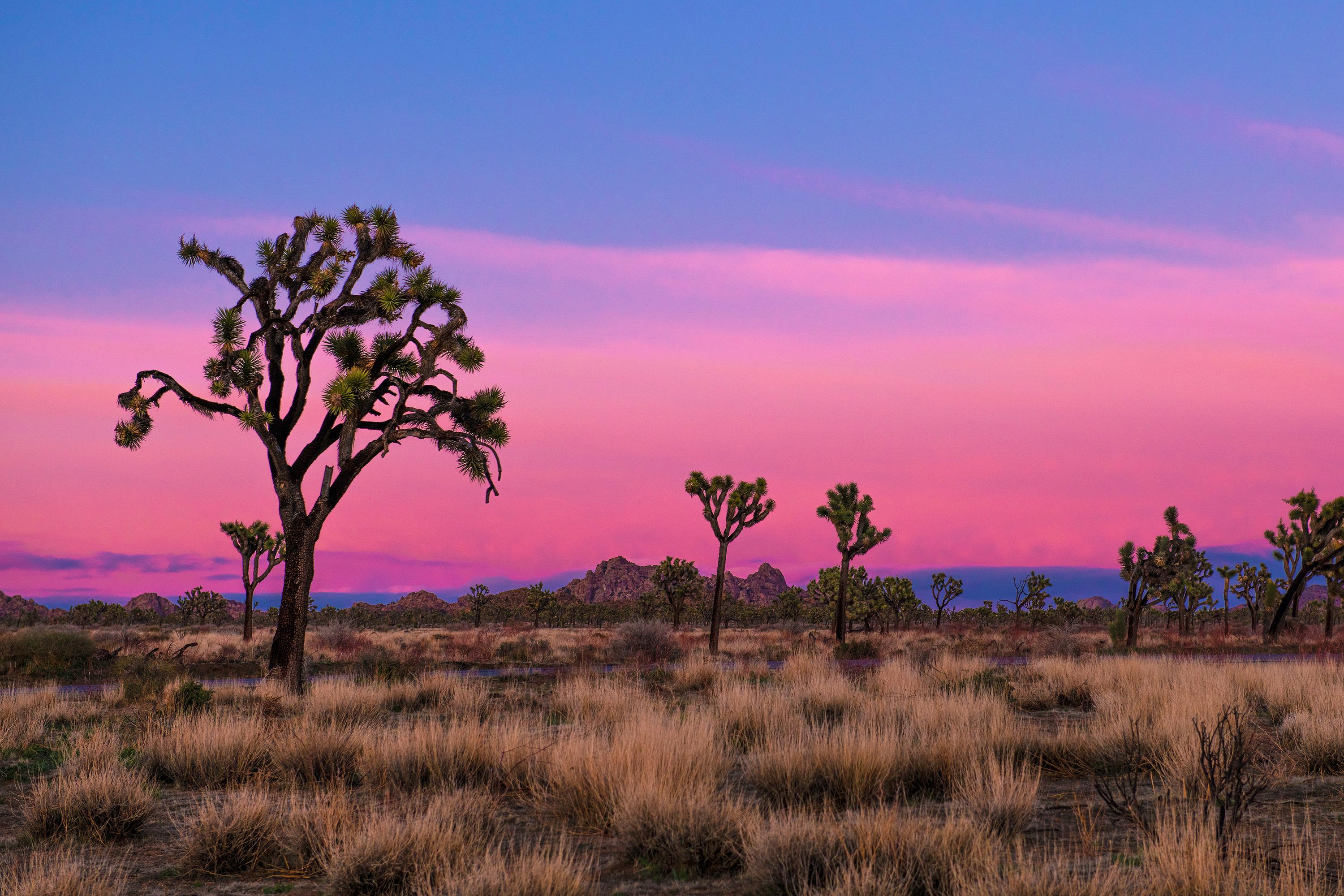
The sky turns hues of pink and purple over a field of Joshua trees at the Quail Springs area.
JOTR · National Park
CA
Last updated
May 28, 2026

When to visit Joshua Tree.

Joshua Tree's three priorities (crowd, weather, dark-sky access) line up cleanly twice a year. The cleanest overall window is mid-October through early December: heat eases, climbers return, and the Pinto Basin Road dark-sky stretch is at its quietest before the holiday spike. March and April are the spring shoulder peak with the wildflower window (rain-dependent), but they are also the year's hardest weekends to book lodging. June through September is hostile heat. NPS advises avoiding 10 a.m. to 5 p.m. hiking.

Annual visits3.06M
BusiestMarch
QuietestJuly
Years on file47
Photo · NPS / Emily Hassell · NPS source
Annual visits · 5-yr avg3.06M2,932,644 in 2025
Busiest monthMarch411K avg visits
Quietest monthJuly3× thinner than March
Best tradeoffNovemberCrowds drop, ops still full
Field note · Joshua Tree
By Nicholas Major Source · NPS + NOAA Updated · May 28, 2026

The best windows at Joshua Tree are mid-October through early December and the March-April bloom shoulder. Heat eases, climbing returns to full schedule, and the Pinto Basin Road's dark-sky stretch is at its quietest before the holiday spike.

Peak months are March (~412,000 visits 5-yr mean) and April (~364,000). The quietest is July, near 137,000, about 33% of March's peak. NOAA July high at Twentynine Palms (1,975 ft) is 104°F.

By mid-October, the sustained heat retreats, Belle, White Tank, and Ryan campgrounds reopen, and climber traffic returns to the Hidden Valley boulders. Joshua Tree is a designated International Dark Sky Park; the Pinto Basin Road between Cholla Cactus Garden and Cottonwood has the darkest skies per NPS.

From June through September, NPS advises avoiding hiking between 10 a.m. and 5 p.m.; daytime highs reach 104°F in July, strenuous trails are on a do-not-attempt list, and the Paul Miller Story on the NPS hiking page is the cautionary record. Verify fees and conditions on the NPS Joshua Tree page.

Visiting Joshua Tree.

Pick your month.

Three independent signals per month; crowd, weather, and access. Tap any row to read the full Joshua Tree guide for that month. We deliberately do not combine these into a single "best month" number; different priorities point at different months.

Sourced · NPS + NOAA
Each score is 0–100
Green = good for visitor on that axis. Yellow = mixed. Orange/red = avoid for that reason. The word inside each chip is the answer; the line beneath is the data behind it.
Month Crowd Weather Access What that means
January
Busy
64% of peak · 265K visits
Ideal
63°F / 42°F (17°C / 5°C) · 0.50″ precip
Full
Composite access score · 100/100
Cool, quiet shoulder. Possible early-season wildflowers in low-rain years. Climbers at full schedule. Long, cold nights for stargazing.Read January →
February
Busy
72% of peak · 295K visits
Ideal
67°F / 44°F (20°C / 7°C) · 0.56″ precip
Full
Composite access score · 100/100
Pleasant mid-60s days, frosty nights. Wildflowers begin if late-fall rain hit the desert. Climber-prime; Presidents' Day pulls a small spike.Read February →
March
Packed
100% of peak · 411K visits
Ideal
74°F / 49°F (23°C / 10°C) · 0.35″ precip
Full
Composite access score · 100/100
Peak month. Wildflower window if it rained; warm clear days; Pinto Basin Road and Joshua Tree silhouettes at full color. Hardest week to book lodging.Read March →
April
Packed
89% of peak · 364K visits
Ideal
81°F / 55°F (27°C / 13°C) · 0.12″ precip
Full
Composite access score · 100/100
Second-peak month. Spring break + lingering bloom drive sustained crowd. Hot afternoons begin late month; sunrise hikes are the rule.Read April →
May
Busy
62% of peak · 254K visits
Mixed
90°F / 63°F (32°C / 17°C) · 0.05″ precip
Full
Composite access score · 90/100
Heat begins. Mornings still workable; afternoons push into the 90s°F. Climbers shift to early morning. Visits drop sharply.Read May →
June
Moderate
43% of peak · 176K visits
Rough
99°F / 71°F (37°C / 22°C) · 0.0″ snow
Mostly open
Composite access score · 75/100
Hostile heat. Avoid hiking 10 a.m. to 5 p.m. per NPS. Dark-sky and Milky Way windows are the practical case for the park.Read June →
July
Quiet
33% of peak · 137K visits
Rough
104°F / 77°F (40°C / 25°C) · 0.40″ precip
Mostly open
Composite access score · 70/100
Quietest month of the year. NOAA July high 104°F at Twentynine Palms. Strenuous trails closed by NPS advisory. Monsoon storms possible.Read July →
August
Quiet
34% of peak · 140K visits
Rough
103°F / 76°F (39°C / 25°C) · 0.65″ precip
Mostly open
Composite access score · 70/100
Hot and quiet. Perseids peak mid-month under desert skies but heat-safety rules apply day and night. Late-month brings monsoon humidity.Read August →
September
Quiet
39% of peak · 162K visits
Rough
97°F / 69°F (36°C / 21°C) · 0.34″ precip
Full
Composite access score · 80/100
Heat begins easing. Mornings comfortable, afternoons still in the mid-90s°F. Climbing season ramps back up.Read September →
October
Moderate
51% of peak · 209K visits
Good
85°F / 58°F (29°C / 14°C) · 0.15″ precip
Full
Composite access score · 95/100
Shoulder transition. Daytime highs into the 80s°F; campgrounds reopen and Ryan returns to the calendar. Visits begin climbing.Read October →
November
Busy
76% of peak · 313K visits
Ideal
72°F / 47°F (22°C / 8°C) · 0.19″ precip
Full
Composite access score · 100/100
Second-peak month again. Thanksgiving week is the densest weekend. Cottonwood and Indian Cove book solid; climber-prime conditions.Read November →
December
Packed
83% of peak · 340K visits
Ideal
62°F / 40°F (17°C / 4°C) · 0.56″ precip
Full
Composite access score · 100/100
Strong shoulder paired with November. Christmas-to-New-Year window is the year's other density spike. Geminids meteor shower mid-month.Read December →
How these scores are computed (and why there's no combined "best month")

Crowd score

Formula: 100 − (this month's visits ÷ park's peak month visits) × 100. Each park scored against its own peak, not against other parks.

Source: NPS Visitor Use Statistics Data Package 2025, Recreation Visits (TRV), 5-year monthly mean (2021-2025). Reproduce these numbers on the NPS IRMA Stats portal.

Reading it: July at Joshua Tree reads 0 (peak). November reads 24 (nearly empty). A 50 means about half the park's peak crowd.

Weather score

Formula: weatherScore = round(max(0, min(100, dayComfort − precipPenalty − snowPenalty − freezePenalty))). The piecewise day-comfort function is continuous at every boundary.

  • Day comfort: tmax < 50°F → max(10, (tmax − 20) × 2) (cold tail); 50–60°F → 60 + (tmax − 50) × 4 (ramp to 100); 60–78°F → 100 (plateau); 78–85°F → 100 − (tmax − 78) × 5 (ramp to 65); > 85°F → max(30, 65 − (tmax − 85) × 5) (hot tail).
  • Precip penalty: max(0, prcpIn − 1.5) × 8; kicks in above 1.5 in / month.
  • Snow penalty: snowIn × 2.5.
  • Night-freeze penalty: max(0, 32 − tmin) × 1.5 when tmin < 32°F.

Source: NOAA NCEI U.S. Climate Normals 1991-2020, station Twentynine Palms, CA (USC00049099, 1,975 ft).

Caveat: The Twentynine Palms cooperative observer station sits at ~1,975 ft on the desert floor north of the park boundary, the same elevation band as the Oasis Visitor Center / North Entrance corridor and most of the visitor footprint at Hidden Valley, Jumbo Rocks, and Pinto Basin Road. The park rises into the high country at Keys View (~5,185 ft), where daytime highs read 15-20°F cooler than Twentynine Palms year-round; the Cottonwood district at ~3,000 ft on the south side runs warmer than the high country but cooler than Twentynine Palms. The Hidden Valley district at ~4,000-4,500 ft is the typical campground band: subtract roughly 10°F from the station readings to estimate Hidden Valley campground conditions. Snowfall at the station is zero in the 1991-2020 normals window; light dustings at Keys View and the high country occur a few days per typical winter. PREVIEW status: no approval row exists yet in data/manual/weather_station_selections.csv for JOTR.

Access score

Formula: For each named park road, count it open if its typical operating window covers that month. Score = round((sum of weights of open roads / sum of all weights) x 100). Where a park has a partial winter access mode, the profile documents that assumption in its access notes.

Route weights at Joshua Tree:

  • Park Boulevard: the year-round scenic loop: Year-round access
  • Pinto Basin Road: the south-corridor dark-sky drive: Year-round access; dark-sky corridor
  • Black Rock and Indian Cove: separate entrances: Year-round road access
  • Entry, fees, and passes: Year-round entry
  • No water in the park (carry your own): Year-round
  • Heat safety: summer trail closures: June through September; heat advisory in effect
  • Campgrounds: reservations and first-come: Year-round (Ryan, Belle, White Tank closed in summer)
  • Lost Horse Mine: vehicle restrictions on access road: Year-round (heat advisory in summer)

Editorial methodology, the route weights themselves are author-curated, sourced from data/processed/operations/road_windows.csv and the park's own access caveats below the score table.

Caveat: The score reflects wheeled-vehicle road access only. Backcountry, hiking, lodging, shuttle, and other service availability are not directly included unless the park profile states otherwise.

Why no combined score?

A combined "best month" number forces a weighting: how much do you care about crowds vs. weather vs. access? Those weights are personal. A photographer optimizing for golden light weights differently than a parent locked to school break weights differently than a winter visitor with a 4WD. We show the inputs and let you decide. Use the per-month grid above to navigate to a deeper page.

For your Joshua Tree trip.

Pick your priority.

Crowd-free trails, full operations, or value-and-solitude. Each card points at a different month; pick the one that fits what you're actually after.

Source · NPS Recreation Visits
5-year monthly mean
If you want

Crowd-free trails

Late January or mid-week summer evenings

The structural quietest stretch is mid-summer (July averages about 137,000 recreation visits, roughly a third of March's peak), but the operational reality is that summer heat closes the strenuous trail set per NPS hiking safety guidance and afternoons are dangerous. The actually-usable crowd-free window is the second and third weeks of January, after the holiday-break visitors leave and before the Presidents' Day weekend pulls a small spike. Daytime highs land in the low 60s°F, nights drop below freezing in the high country, and Hidden Valley campground (year-round, first-come) typically has midweek openings. The other usable window is summer evenings after 5 p.m., when temperatures begin to ease and the climber-and-stargazer crowd takes over the boulders.

Read the Late January or mid-week summer evenings deep-dive →
If you want

Full operations

March

March is the year's peak demand month at Joshua Tree by 5-year mean (~412,000 recreation visits, about 14% above April's secondary peak) and also when every operational system runs at full schedule. Park Boulevard, Pinto Basin Road, and the Cottonwood corridor all open year-round, the Belle, White Tank, and Ryan campgrounds are back from their summer closures, climbing has returned to the boulders in force, and the wildflower window, if winter rain delivered, is open. The cost is crowd density: reservation campgrounds (Black Rock, Indian Cove, Jumbo Rocks, Ryan, Cottonwood) book to the 6-month-out window on Recreation.gov the moment they release, and Twentynine Palms / Joshua Tree / Yucca Valley lodging tightens to near-sold-out on weekends.

Read the March deep-dive →
If you want

Value & solitude

Mid-October through early December · late February

The cleanest value-and-solitude window is mid-October through the first week of December. Daytime highs ease from the mid-80s°F at month-start October into the 60s°F by early December, summer heat closures lift, the Belle, White Tank, and Ryan campgrounds reopen, and the November and Thanksgiving-week peak hits but the gaps between are noticeably quieter than the March-April bloom shoulder. Hidden Valley and Cottonwood Visitor Center foot traffic returns to normal cadence. The other quiet window inside the high-demand season is late February, the lull between the Presidents' Day weekend bump and the March wildflower-and-spring-break peak. Daytime highs in the mid-60s°F, nights still cold at the high-country elevations, and reservation campgrounds typically have some midweek availability before the March release wave hits.

Read the winter guide →
For photographers · flexible calendar

The light, the window.

Joshua Tree's best light is sunrise and sunset on the Joshua tree silhouettes, and the new-moon Milky Way window over Pinto Basin Road.

Joshua Tree photographs best at the cardinal-light windows: sunrise on the boulder-and-Joshua-tree forests at Hidden Valley, Quail Springs, and Lost Horse Valley, and sunset against the Wonderland of Rocks from Cap Rock and Keys View. Keys View at ~5,185 ft is the standard sunset platform: the overlook takes in the Coachella Valley, the Salton Sea, and the San Andreas Fault line, and the high-pressure offshore-flow days deliver the cleanest visibility (winter and early spring are sharpest; summer haze cuts the view). Joshua Tree is also a designated International Dark Sky Park, and NPS specifically names Cottonwood Campground and the Pinto Basin Road between Cholla Cactus Garden and Cottonwood as the darkest-sky stretches. The Milky Way is at its best on a moonless summer night per the NPS stargazing page. The catch is the heat, which makes the night-photography window operationally hostile from June through September without an air-conditioned camping setup. Winter new-moon weeks deliver the cleanest dry-air dark-sky photography of any major U.S. National Park within range of Los Angeles, and the annual Joshua Tree National Park Night Sky Festival in the fall is the park's signature astronomy event.

Sunrise & sunset at the cardinal dates

DateSunriseSunset
March 21 (vernal equinox)6:46 AM6:57 PM
June 21 (summer solstice)5:34 AM7:58 PM
September 21 (autumnal equinox)6:32 AM6:42 PM
December 21 (winter solstice)6:45 AM4:39 PM
Times at the park's NPS API coordinate (33.91°N, 116.0°W). Source: U.S. Naval Observatory Rise/Set/Transit/Twilight Data. Pacific Time (PDT March-November; PST December-February). California observes DST; treat the March-November times as PDT.
Sunrise on the Joshua tree forest at Hidden Valley, Quail Springs, and Lost Horse Valley
Year-round; warmest color October through April

First light hits the Joshua tree silhouettes against the bouldered backdrop. Drive Park Boulevard in pre-dawn dark and stop at Quail Springs, Hidden Valley turnouts, or Lost Horse Valley pullouts. Cooler months avoid the morning heat-haze that flattens the summer light.

Sunset at Keys View, with Coachella Valley and the San Andreas Fault
Year-round; clearest visibility November through March

Keys View at ~5,185 ft is the only major overlook for the Coachella Valley, the Salton Sea, and the San Andreas Fault line. Winter cold-front days deliver the sharpest visibility; summer haze cuts the view. Arrive 30 minutes before sunset for parking; the lot is small.

Milky Way over Pinto Basin Road / Cottonwood
Late May through early September new-moon weeks (galactic-center prime)

NPS notes the Milky Way is at its best on a moonless summer night and names the Pinto Basin Road between Cholla Cactus Garden and Cottonwood as the darkest-sky stretch. The operational catch is the summer heat; plan around an air-conditioned campground night at Cottonwood, the southern campground with the darkest skies.

Cholla Cactus Garden at sunrise / sunset
Year-round; cleanest in October-April

The Cholla (teddy-bear cholla) backlights with rim-light at sunrise and sunset; the short loop walks through a dense patch on Pinto Basin Road. Stay on the trail (cholla joints detach and hurt).

Joshua Tree National Park Night Sky Festival
Annual; typically autumn (verify on NPS Joshua Tree)

The park's signature astronomy event includes ranger talks, telescopes, and night-photography programs. NPS hosts the festival annually; confirm the current year's dates on the NPS Joshua Tree stargazing page.

Spring wildflower bloom (rain-dependent)
Late February through April in normal years; March-April peak in big bloom years

Wildflowers usually start in January and February at the low elevations and move up through the high country into April. Big bloom years require ≥0.5 inches of rain in a single late-fall or winter event per the NPS Joshua Tree blooms page; spectacular displays are the exception, not the rule.

Air quality & smoke check: NPS Joshua Tree air quality

Joshua Tree crowds, by month.

Average recreation visits at Joshua Tree National Park, calendar order. Each bar is normalised to the park's peak month; taller bar, busier month. Tap a row to read the park-month page.

Statistic · TRV
Window · 5 years
Month Crowd vs peak month Avg visits (5-yr) % of peak Band What's actually happening
JanuaryJan
264,502↑ 278,104 latest 64/ 100 High Cool, quiet shoulder. Possible early-season wildflowers in low-rain years. Climbers at full schedule. Long, cold nights for stargazing.
FebruaryFeb
294,966↑ 298,792 latest 72/ 100 High Pleasant mid-60s days, frosty nights. Wildflowers begin if late-fall rain hit the desert. Climber-prime; Presidents' Day pulls a small spike.
MarchMar
410,905↑ 411,993 latest 100/ 100 Peak Peak month. Wildflower window if it rained; warm clear days; Pinto Basin Road and Joshua Tree silhouettes at full color. Hardest week to book lodging.
AprilApr
363,663↓ 341,516 latest 89/ 100 Peak Second-peak month. Spring break + lingering bloom drive sustained crowd. Hot afternoons begin late month; sunrise hikes are the rule.
MayMay
253,671↓ 230,328 latest 62/ 100 High Heat begins. Mornings still workable; afternoons push into the 90s°F. Climbers shift to early morning. Visits drop sharply.
JuneJun
175,980↓ 155,366 latest 43/ 100 Moderate Hostile heat. Avoid hiking 10 a.m. to 5 p.m. per NPS. Dark-sky and Milky Way windows are the practical case for the park.
JulyJul
136,502↑ 139,664 latest 33/ 100 Moderate Quietest month of the year. NOAA July high 104°F at Twentynine Palms. Strenuous trails closed by NPS advisory. Monsoon storms possible.
AugustAug
140,063↑ 142,794 latest 34/ 100 Moderate Hot and quiet. Perseids peak mid-month under desert skies but heat-safety rules apply day and night. Late-month brings monsoon humidity.
SeptemberSep
161,892↓ 148,905 latest 39/ 100 Moderate Heat begins easing. Mornings comfortable, afternoons still in the mid-90s°F. Climbing season ramps back up.
OctoberOct
209,037↓ 163,674 latest 51/ 100 Moderate Shoulder transition. Daytime highs into the 80s°F; campgrounds reopen and Ryan returns to the calendar. Visits begin climbing.
NovemberNov
312,571↓ 295,800 latest 76/ 100 High Second-peak month again. Thanksgiving week is the densest weekend. Cottonwood and Indian Cove book solid; climber-prime conditions.
DecemberDec
339,772↓ 325,708 latest 83/ 100 High Strong shoulder paired with November. Christmas-to-New-Year window is the year's other density spike. Geminids meteor shower mid-month.
March caveat

Joshua Tree's March monthly mean (~412,000 visits, the year's peak) blends a quiet early-March stretch with a hard mid-March-through-spring-break ramp. Wildflower-year intensity also varies year to year: superblooms are the exception, not the rule per NPS, and require ≥0.5 inches of rain in a single late-fall or winter event to deliver. In a no-rain year, the March crowd peak still hits but the bloom is muted. Treat the March peak as a reliable demand signal, not as a guarantee of color. We don't yet publish weekly NPS counts on this page; when we do, the March curve will show the early-month-vs-spring-break split explicitly.

Joshua Tree weather, by month.

NOAA climate normals 1991-2020 for the station closest to park headquarters. Use it as a planning floor, not a forecast, and read the elevation caveat below.

NOAA NCEI · 1991-2020
Station · Twentynine Palms, CA
Month Temperature range (°F) High Low Precip (in) Snow (in) Verdict
January
63°°F high 42°°F low 0.50inches 0.0inches Shoulder
February
67°°F high 44°°F low 0.56inches 0.0inches Shoulder
March
74°°F high 49°°F low 0.35inches 0.0inches Warm
April
81°°F high 55°°F low 0.12inches 0.0inches Hot
May
90°°F high 63°°F low 0.05inches 0.0inches Hot
June
99°°F high 71°°F low 0.00inches 0.0inches Hot
July
104°°F high 77°°F low 0.40inches 0.0inches Hot
August
103°°F high 76°°F low 0.65inches 0.0inches Hot
September
97°°F high 69°°F low 0.34inches 0.0inches Hot
October
85°°F high 58°°F low 0.15inches 0.0inches Hot
November
72°°F high 47°°F low 0.19inches 0.0inches Warm
December
62°°F high 40°°F low 0.56inches 0.0inches Shoulder
Source: NOAA NCEI U.S. Climate Normals 1991-2020 · station Twentynine Palms, CA (USC00049099, 1,975 ft).
Elevation caveat: The Twentynine Palms cooperative observer station sits at ~1,975 ft on the desert floor north of the park boundary, the same elevation band as the Oasis Visitor Center / North Entrance corridor and most of the visitor footprint at Hidden Valley, Jumbo Rocks, and Pinto Basin Road. The park rises into the high country at Keys View (~5,185 ft), where daytime highs read 15-20°F cooler than Twentynine Palms year-round; the Cottonwood district at ~3,000 ft on the south side runs warmer than the high country but cooler than Twentynine Palms. The Hidden Valley district at ~4,000-4,500 ft is the typical campground band: subtract roughly 10°F from the station readings to estimate Hidden Valley campground conditions. Snowfall at the station is zero in the 1991-2020 normals window; light dustings at Keys View and the high country occur a few days per typical winter. PREVIEW status: no approval row exists yet in data/manual/weather_station_selections.csv for JOTR.
Preview · pending pipeline verification

Year over year.

Annual recreation visits at Joshua Tree National Park, 2015–2025. Hover any bar to compare; the chart is the same record the agency itself publishes.

Source · NPS IRMA Stats
Statistic · Recreation Visits
2.03M
2.51M
2.85M
2.94M
2.99M
2.40M
3.06M
3.06M
3.27M
2.99M
2.93M
2015
2016
2017
2018
2019
2020Pandemic-year drop
2021Post-pandemic recovery
2022
2023All-time record
2024
2025
Latest annual2,932,644
5-year mean3,063,523
11-year record high3,270,404 in 2023

Access & operations.

Roads, lodges, entrances. The seasonal pattern that turns a good plan on paper into a workable one in the field. Verify with NPS before you travel; these change.

Independent summary
Last updated · May 28, 2026
Year-round access

Park Boulevard: the year-round scenic loop

The main paved through-route runs from the West Entrance (Joshua Tree, CA) through Hidden Valley and Cap Rock to the North Entrance (Twentynine Palms, CA) and connects to Pinto Basin Road for the south-loop drive. Open year-round, no seasonal closures; weather-driven advisories occasionally close short stretches in monsoon-season flash flood weather (mid-July to early September). Verify current status on the NPS Joshua Tree conditions page.

Year-round access; dark-sky corridor

Pinto Basin Road: the south-corridor dark-sky drive

The 30-mile paved drive from Park Boulevard south through Cholla Cactus Garden and the Pinto Basin to Cottonwood Visitor Center and the I-10 south entrance near Mecca, CA. Open year-round and is the park's dark-sky corridor: NPS notes the Pinto Basin Road between Cholla Cactus Garden and Cottonwood has the darkest skies and least traffic in the park. The Cottonwood Entrance is the practical south access from I-10.

Year-round road access

Black Rock and Indian Cove: separate entrances

Black Rock Canyon (accessed via Joshua Lane off CA-247 north of Yucca Valley) and Indian Cove (off CA-62 between Joshua Tree and Twentynine Palms) are both inside the park but do not connect to the main Park Boulevard loop. Each is reached by its own entrance road from outside the park. Both have their own campgrounds and trailheads (Black Rock: 99 sites, reservation-required; Indian Cove: 101 sites, reservation-required) per the NPS Joshua Tree campgrounds page.

Year-round entry

Entry, fees, and passes

The 7-day private vehicle pass is $30, motorcycle pass is $25, and individual on foot or bike is $15 per the NPS Joshua Tree fees page. The Joshua Tree National Park Annual Pass is $55; the America the Beautiful annual federal pass is $80. The Senior Lifetime Pass for U.S. citizens 62+ is $80 (or $20 annual). No timed-entry reservation system at Joshua Tree.

Year-round

No water in the park (carry your own)

Drinkable water is available only at Black Rock Campground (near campsite 6), Cottonwood Visitor Center, and the Oasis Visitor Center area in Twentynine Palms. There is no water at Hidden Valley, Jumbo Rocks, Belle, White Tank, Ryan, Indian Cove, or any of the trailheads in the Hidden Valley district. NPS hiking guidance is to carry plenty of food and water even on short hikes; the dry desert air makes dehydration the principal underrated risk. Verify the current water fill stations on the campgrounds page.

June through September; heat advisory in effect

Heat safety: summer trail closures

From June through September, NPS specifically advises avoiding hiking between 10 a.m. and 5 p.m., and lists strenuous trails (Boy Scout, Lost Horse Mine loop and other strenuous routes) as do-not-attempt during summer heat per the NPS Joshua Tree hiking page. The Paul Miller Story on the same page is the published cautionary record of summer-heat hiker fatalities. Plan summer trips around sunrise and after-sunset windows; mid-day belongs to the visitor centers, the air-conditioned car, or a dark-sky reservation back at the campground.

Year-round (Ryan, Belle, White Tank closed in summer)

Campgrounds: reservations and first-come

Reservation-required campgrounds: Black Rock (99 sites, year-round), Indian Cove (101 sites, year-round), Jumbo Rocks (124 sites, year-round), Ryan (31 sites, closed in summer), and Cottonwood (62 sites, year-round), all bookable up to 6 months in advance through Recreation.gov. First-come, first-served: Hidden Valley (44 sites, year-round), Belle (18 sites, closed in summer), White Tank (closed in summer). The Black Rock and Cottonwood campgrounds are the only ones with water fill stations and dump stations per the NPS campgrounds page.

Year-round (heat advisory in summer)

Lost Horse Mine: vehicle restrictions on access road

The trailhead access road to Lost Horse Mine is a dirt spur off Keys View Road; standard passenger vehicles handle it without issue, but RVs over 25 ft and any vehicles towing trailers are restricted. The Lost Horse Mine loop is on the NPS strenuous-hike summer-heat do-not-attempt list. Verify current status on the conditions page.

For families with kids · year-round

Junior Ranger.

Joshua Tree's Junior Ranger program lets kids work through an activity book, observe the desert, and earn a Junior Ranger badge. The current activity book is available at all park visitor centers; confirm the booklet price at the visitor-center desk on arrival. A Virtual Junior Ranger track is also offered through the park's For Kids page if you can't visit a desk. The Every Kid Outdoors federal pass gives U.S. 4th graders a free entry pass for the year; bring the printed voucher from the federal site to the entrance station or visitor center.

Joshua Tree Junior Ranger: pick up a book at any park visitor center.
Age tiers
  • All ages: The activity book scales with adult help; the desert ecology and stargazing chapters work for any reader.
  • Pre-readers: Parents read prompts aloud and help with the observation activities. Cholla Cactus Garden Loop, Skull Rock, and the Bajada All-Access Nature Trail are the easiest stops.
  • Older kids and teens: Joshua tree natural history, Mojave Desert ecology, and dark-sky astronomy are the strongest tracks. Pair with the Night Sky Festival in the fall for a real astronomy hook.
CostConfirm the current Joshua Tree Junior Ranger book price at any park visitor center on arrival; a Virtual Junior Ranger option is also available through the NPS Joshua Tree For Kids page.
Where to get itOasis Visitor Center (Twentynine Palms, near the North Entrance), Joshua Tree Visitor Center (Joshua Tree, near the West Entrance), Cottonwood Visitor Center (south entrance off I-10), or the Black Rock Nature Center (when staffed in season).
Time to complete2-4 hours of in-park activities; can be done across multiple days. The Cholla Cactus Garden Loop, Skull Rock, and Hidden Valley nature trails are the highest-yield stops for the activity book.
Badge ceremonyReturn the completed book to a visitor center for the swearing-in and badge. Like other NPS units, you must be in the park to receive the badge.
Visiting Joshua Tree.

Older travelers, RVs, and mobility.

Joshua Tree works well for senior visitors. The Bajada All-Access Nature Trail off Pinto Basin Road, the Cholla Cactus Garden Loop (graded gravel), the Hidden Valley Picnic Area paths, and the Keys View overlook are all accessible-grade short walks with major payoff. The gateway towns (Twentynine Palms, Joshua Tree, Yucca Valley) are all near sea level, so altitude is not a concern. The principal age-relevant constraint is heat: NPS specifically advises avoiding hiking between 10 a.m. and 5 p.m. in summer. For senior travelers, anchor any May-September trip on a Twentynine Palms or Joshua Tree hotel with a pool and AC, and plan all activity for sunrise and after-sunset windows. The Senior Lifetime Pass for U.S. citizens 62+ is $80 (one-time), or the $20 Senior Annual Pass; both cover entry to all U.S. national parks. For RV detail (length limits, hookups, dump stations), see the RV section below.

Audience-segmented
Senior & mobility-aware

Joshua Tree is a strong senior park: short paved nature trails, a major sunset overlook with a small accessible loop, and no altitude issue at the gateway towns.

Accessible-grade short walks

The Bajada All-Access Nature Trail (Pinto Basin Road, paved 0.25-mile loop), the Cholla Cactus Garden Loop (graded gravel 0.25-mile loop), Skull Rock (short walk from a Park Boulevard pullout), and the Hidden Valley Picnic Area paths cover the major desert ecology and rock-formation scenes without long-mileage hiking.

Keys View at ~5,185 ft

The signature sunset overlook: a small paved area off Keys View Road with a short accessible-grade loop. Takes in the Coachella Valley, the Salton Sea, and the San Andreas Fault line. Plan to arrive 30 minutes before sunset for parking and bring a jacket; temperatures at the overlook run 15-20°F below the gateway towns at elevation.

Hotel-first lodging in the gateway towns

Twentynine Palms (the dominant Oasis Visitor Center / North Entrance base, with full motels, the historic 29 Palms Inn, and several boutique hotels), Joshua Tree (more limited but well-positioned for the West Entrance), and Yucca Valley (more amenities, ~15 mi from the West Entrance) all run year-round at sea-level altitudes. No in-park lodges at Joshua Tree.

Heat advisory in effect May through September

NPS advises avoiding hiking 10 a.m. to 5 p.m. in summer; for senior travelers, the practical rule is shift all in-park activity to sunrise hours and after-sunset windows. Stay hydrated; the dry desert air makes dehydration feel less obvious than it is.

Senior Pass

The Senior Lifetime Pass for U.S. citizens 62+ is $80 (one-time), or the $20 Senior Annual Pass per the NPS Joshua Tree fees page. Both cover entry to all U.S. National Parks.

For RV travelers · length matters

RV & big-rig.

No hookups inside Joshua Tree; campground length limits vary per campground (25-foot cap at Hidden Valley, White Tank, and Lost Horse Mine access; up to 35 ft at Belle with most sites tighter).

Joshua Tree is a workable RV park for the right rig at the right campground but with one persistent constraint: there are no full-hookup sites inside the park. Dump stations and water fill stations are at Black Rock Campground (near campsite 6) and Cottonwood (between the visitor center and the campground) only; every other campground is dry. Length limits vary per campground: Hidden Valley and White Tank cap at 25 feet combined (RV + trailer), Belle accommodates up to 35 feet but most sites only 25-30 feet, the Indian Cove Group cap is 25 feet, and Black Rock, Indian Cove, Jumbo Rocks, Cottonwood, and Ryan have site-by-site limits. Confirm individual sites on Recreation.gov before booking. The Lost Horse Mine access road off Keys View Road is a graded dirt spur and is closed to RVs over 25 feet and any towing combination. Full-hookup RV parks are outside the park in Twentynine Palms, Joshua Tree, and Yucca Valley.

RV length limits by road

Where your rig fits (and doesn't)

  • Park Boulevard / Pinto Basin Road (paved through-routes)Advisory; No formal NPS length cap on the paved through-routes; both handle the largest rigs without issue. Watch the parking-area sizes at Skull Rock, Cholla Cactus Garden, and the Hidden Valley district trailheads; rigs over 30 ft will struggle for a spot midday.
  • Hidden Valley Campground (first-come, first-served)Max 25 ft; NPS sets a 25-foot combined RV+trailer length limit at Hidden Valley per the NPS campgrounds page. Open year-round; first-come, first-served.
  • White Tank Campground (first-come, first-served)Max 25 ft; NPS sets a 25-foot combined length limit at White Tank per the campgrounds page. Closed in summer.
  • Belle Campground (first-come, first-served)Max 35 ft; Per NPS, Belle 'can accommodate up to 35 feet but most only accommodate 25-30 feet RV's.' Closed in summer.
  • Black Rock, Indian Cove, Jumbo Rocks, Cottonwood, Ryan (reservation)Advisory; Site-by-site limits. Confirm individual sites on Recreation.gov before booking. Indian Cove Group Campground caps combined length at 25 feet. Ryan is closed in summer.
  • Lost Horse Mine access road (graded dirt spur off Keys View Road)Max 25 ft; Closed to RVs over 25 ft and any towing combinations. Standard passenger vehicles handle it. The Lost Horse Mine loop hike is on the NPS strenuous-hike summer-heat do-not-attempt list.
In-park hookups

Full hookups inside the park

None. Joshua Tree has no full-hookup campgrounds inside the park. Black Rock and Cottonwood have dump stations and water fill stations; every other campground is dry. Reservable through Recreation.gov 6 months ahead.

Dump stations

Where to dump tanks

Inside the park: Black Rock Campground (near campsite 6) and Cottonwood (between the visitor center and the campground) only. Outside the park: full-hookup RV parks in Twentynine Palms, Joshua Tree, and Yucca Valley offer dump service to non-guests for a fee; call ahead.

Outside-the-park

Nearby RV parks

  • Twentynine Palms Resort RV Park (Twentynine Palms), ~5 mi northwest of the Oasis Visitor Center / North Entrance
  • Joshua Tree Lake RV & Campground (Joshua Tree, CA), ~6 mi west of the West Entrance off CA-62
  • Yucca Valley RV Park (Yucca Valley, CA), ~15 mi west of the West Entrance off CA-62
  • Sky Valley Resort (south side, near I-10), ~25 mi south of the Cottonwood Entrance off I-10
Leave the rig parked

Reaching signature sights without the RV

Park the rig at a private RV park in Twentynine Palms, Joshua Tree, or Yucca Valley and day-drive the scenic loop in a small vehicle. There is no in-park shuttle; private vehicles are the only way to reach the trailheads. For the southern Pinto Basin Road / Cottonwood / dark-sky stretch, the Cottonwood entrance off I-10 near Mecca is a 25-mi drive from Indio with no traffic. Lost Horse Mine and the high-country trailheads need a small vehicle even with a hookup at the gateway town.

How this page
is built.

Independent, reader-supported.
Not affiliated with or endorsed
by the National Park Service.

Crowd numbers on this page are the Recreation Visits column from the NPS Visitor Use Statistics Data Package, 2025. Monthly figures are five-year arithmetic means (2021-2025) against each park's own peak month. We do not compare parks against each other for the crowd score: only against themselves.

Weather numbers are NOAA NCEI U.S. Climate Normals 1991-2020, drawn from the Twentynine Palms, CA station (USC00049099). The station sits at 1,975 ft; the elevation caveat above the weather table explains where this misreads the higher districts.

Access notes are an independent summary of NPS operating posture. We do not republish NPS pages; we link them. Conditions change; confirm road status, reservation requirements, and lodging windows on https://www.nps.gov/jotr/index.htm before travel.

Crowd sourceNPS Visitor Use Statistics Data Package
Crowd range1979-2025
Weather sourceNOAA NCEI Normals
Weather period1991-2020
Last-mile check
The Almanac Mailing

The next Joshua Tree
window, in your inbox.

One email a month. The park to point at, the week to book, the trail that's about to fill up. Unsubscribe in a click.

One email per month. We file your address with care.