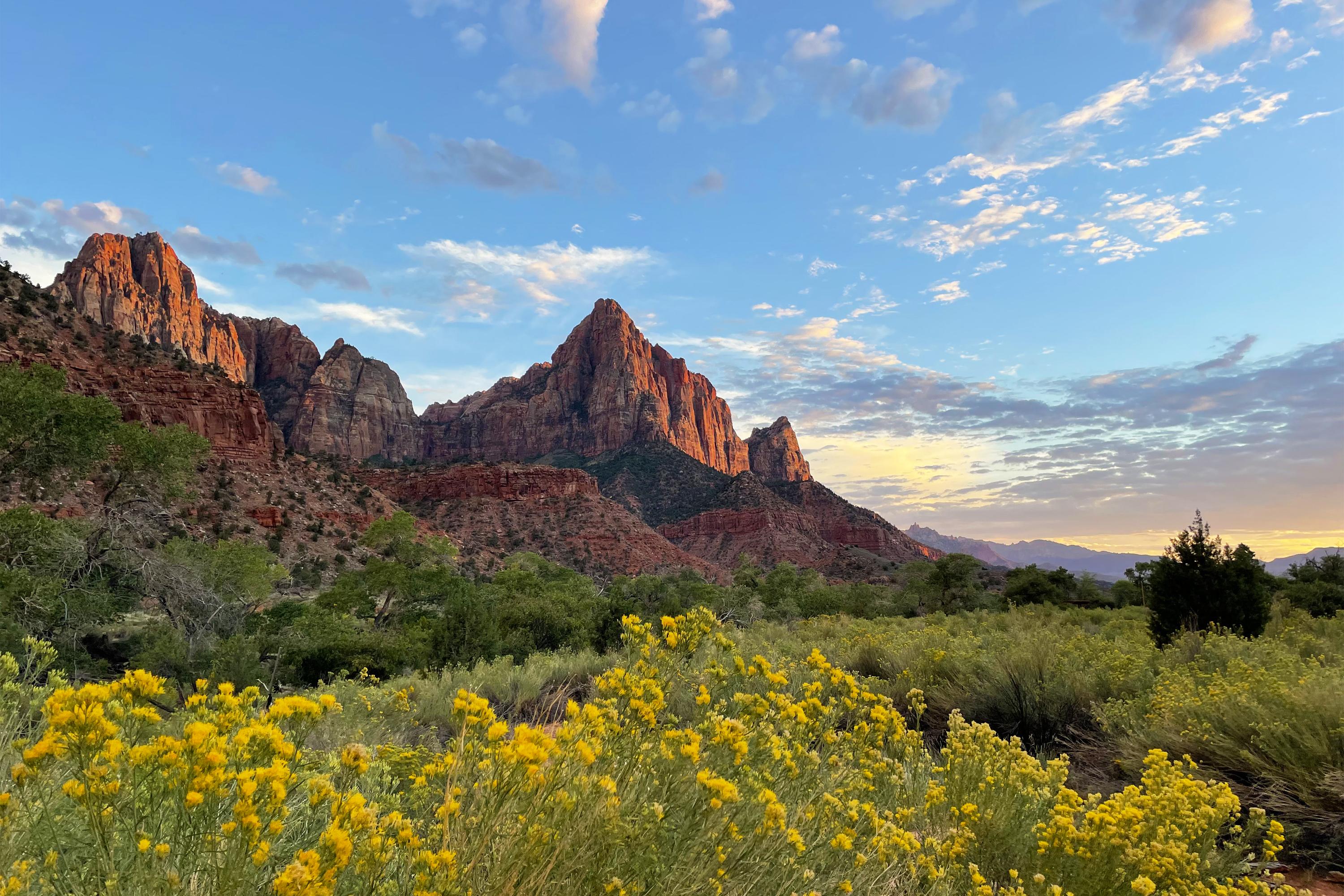
A triangular sandstone mountain overlooks green and yellow foliage under a cloudy blue sky.
ZION · National Park
UT
Last updated
May 19, 2026

When to visit Zion.

Zion's three priorities: crowd, weather, access. Point at different windows. The cleanest overall tradeoff is mid-September through October: heat eases, the monsoon fades, the shuttle is still running, and post-Labor Day school restart pulls crowds below the spring peak. April-May is the next-best window for cooler hiking weather, with crowds nearly as high. Avoid mid-day below-rim hikes from June through August.

Annual visits4.86M
BusiestJune
QuietestJanuary
Years on file47
Photo · NPS/Shane Carte · NPS source
Annual visits · 5-yr avg4.86M4,984,525 in 2025
Busiest monthJune602K avg visits
Quietest monthJanuary4× thinner than June
Best tradeoffOctoberCrowds drop, ops still full
Field note · Zion
By Nicholas Major Source · NPS + NOAA Updated · May 19, 2026

The best overall window at Zion is mid-September through October. Triple-digit heat eases, the monsoon fades, the shuttle is still running, and the post-Labor Day school restart pulls crowds below the spring peak.

Peak month is June, with a five-year mean of about 602,000 recreation visits. The quietest is January, near 139,000, about 23% of June's peak. Afternoon highs in Zion Canyon (~4,038 ft) reach 95-100°F in July and August.

By mid-September, the monsoon is largely past and afternoon temperatures ease. The Zion Canyon Shuttle is still running early in October, cottonwoods along the Virgin River turn gold by mid-October, and crowds slip well below the April-June peak once schools restart.

From December through February, the shuttle stops and private vehicles may drive Zion Canyon Scenic Drive directly. Expect cold nights, short daylight, and occasional snow on Kolob Terrace; the quietest stretch of the year.

Visiting Zion.

Pick your month.

Three independent signals per month; crowd, weather, and access. Tap any row to read the full Zion guide for that month. We deliberately do not combine these into a single "best month" number; different priorities point at different months.

Sourced · NPS + NOAA
Each score is 0–100
Green = good for visitor on that axis. Yellow = mixed. Orange/red = avoid for that reason. The word inside each chip is the answer; the line beneath is the data behind it.
Month Crowd Weather Access What that means
January
Quiet
23% of peak · 139K visits
Good
54°F / 30°F (12°C / -1°C) · 0.7″ snow
Mostly open
Composite access score · 75/100
Quietest month. Shuttle off; private cars allowed up Zion Canyon. Cold nights, short days, possible ice on shaded trails.Read January →
February
Quiet
25% of peak · 153K visits
Ideal
58°F / 34°F (14°C / 1°C) · 0.8″ snow
Mostly open
Composite access score · 75/100
Crowds still light. Mt. Carmel Highway open; shuttle typically not yet running. Slot canyons cold and risky from snowmelt.Read February →
March
Busy
68% of peak · 411K visits
Ideal
66°F / 39°F (19°C / 4°C) · 0.7″ snow
Full
Composite access score · 85/100
Spring break and shuttle restart push visits sharply higher. Confirm shuttle dates on the NPS Zion page.Read March →
April
Packed
81% of peak · 485K visits
Ideal
73°F / 44°F (23°C / 7°C) · 1.22″ precip
Full
Composite access score · 100/100
Heavy spring traffic. Shuttle running. Cottonwood leaf-out. Cool mornings, comfortable rim days.Read April →
May
Packed
94% of peak · 569K visits
Good
84°F / 53°F (29°C / 11°C) · 0.77″ precip
Full
Composite access score · 100/100
Near-peak crowd. Shuttle full, parking gone by mid-morning. Reliable warm dry weather; Narrows snowmelt may still spike.Read May →
June
Packed
100% of peak · 602K visits
Rough
95°F / 62°F (35°C / 17°C) · 0.23″ precip
Full
Composite access score · 100/100
Peak month. Triple-digit afternoons begin. Plan trailheads at sunrise; hike rim trails, not exposed Angels Landing midday.Read June →
July
Packed
92% of peak · 553K visits
Rough
100°F / 70°F (38°C / 21°C) · 1.15″ precip
Full
Composite access score · 100/100
Heat and monsoon storms. Flash-flood risk in slot canyons (NPS safety). Visits high but easing slightly from June.Read July →
August
Busy
77% of peak · 462K visits
Rough
98°F / 69°F (37°C / 20°C) · 1.63″ precip
Full
Composite access score · 100/100
Monsoon continues. Still very hot. Crowds drop modestly. Watch the NPS flash-flood forecast before any slot-canyon plan.Read August →
September
Busy
79% of peak · 476K visits
Rough
91°F / 61°F (33°C / 16°C) · 1.17″ precip
Full
Composite access score · 100/100
Best tradeoff month. Heat eases, monsoon fading, shuttle still running, school-restart pull below summer peaks.Read September →
October
Packed
82% of peak · 491K visits
Ideal
78°F / 49°F (26°C / 9°C) · 1.22″ precip
Full
Composite access score · 100/100
Strong shoulder month. Cottonwoods turn gold. Shuttle still running early; confirm late-October service on the NPS page.Read October →
November
Moderate
50% of peak · 301K visits
Ideal
64°F / 37°F (18°C / 3°C) · 1.18″ precip
Full
Composite access score · 90/100
Shuttle typically winds down. Crowds drop sharply. Cool clear rim weather; some trails frost early.Read November →
December
Quiet
36% of peak · 215K visits
Good
53°F / 29°F (11°C / -1°C) · 1.7″ snow
Mostly open
Composite access score · 75/100
Quiet month, mild for the Colorado Plateau. Shuttle off; drive up Zion Canyon. Snow possible on Kolob Terrace.Read December →
How these scores are computed (and why there's no combined "best month")

Crowd score

Formula: 100 − (this month's visits ÷ park's peak month visits) × 100. Each park scored against its own peak, not against other parks.

Source: NPS Visitor Use Statistics Data Package 2025, Recreation Visits (TRV), 5-year monthly mean (2021-2025). Reproduce these numbers on the NPS IRMA Stats portal.

Reading it: July at Zion reads 0 (peak). November reads 50 (nearly empty). A 50 means about half the park's peak crowd.

Weather score

Formula: weatherScore = round(max(0, min(100, dayComfort − precipPenalty − snowPenalty − freezePenalty))). The piecewise day-comfort function is continuous at every boundary.

  • Day comfort: tmax < 50°F → max(10, (tmax − 20) × 2) (cold tail); 50–60°F → 60 + (tmax − 50) × 4 (ramp to 100); 60–78°F → 100 (plateau); 78–85°F → 100 − (tmax − 78) × 5 (ramp to 65); > 85°F → max(30, 65 − (tmax − 85) × 5) (hot tail).
  • Precip penalty: max(0, prcpIn − 1.5) × 8; kicks in above 1.5 in / month.
  • Snow penalty: snowIn × 2.5.
  • Night-freeze penalty: max(0, 32 − tmin) × 1.5 when tmin < 32°F.

Source: NOAA NCEI U.S. Climate Normals 1991-2020, station Zion National Park, UT (USC00429717, 4,038 ft).

Caveat: Zion NP station sits inside the park at ~4,038 ft, near the Zion Canyon Visitor Center elevation. These numbers represent the Zion Canyon floor (south entrance, Springdale, the main shuttle corridor). The Kolob Terrace and Kolob Canyons districts sit much higher (6,000-7,500 ft) and run significantly cooler and snowier in winter. Inner canyon temperatures in summer can read several degrees hotter than this station on still afternoons.

Access score

Formula: For each named park road, count it open if its typical operating window covers that month. Score = round((sum of weights of open roads / sum of all weights) x 100). Where a park has a partial winter access mode, the profile documents that assumption in its access notes.

Route weights at Zion:

  • Zion Canyon Scenic Drive (the main artery): Shuttle most of year · private cars in winter
  • Zion-Mount Carmel Highway (SR-9): Open year-round
  • Kolob Terrace Road: Upper section closed fall → mid-spring
  • Kolob Canyons Road: Mostly open · winter storm closures
  • Angels Landing permit: Year-round permit system
  • The Narrows (bottom-up day hike): Closes during high water · monsoon flash-flood risk
  • Entry, fees, and timed entry: Year-round entry · no timed entry
  • Lodging: Year-round · Springdale walkable base

Editorial methodology, the route weights themselves are author-curated, sourced from data/processed/operations/road_windows.csv and the park's own access caveats below the score table.

Caveat: The score reflects wheeled-vehicle road access only. Backcountry, hiking, lodging, shuttle, and other service availability are not directly included unless the park profile states otherwise.

Why no combined score?

A combined "best month" number forces a weighting: how much do you care about crowds vs. weather vs. access? Those weights are personal. A photographer optimizing for golden light weights differently than a parent locked to school break weights differently than a winter visitor with a 4WD. We show the inputs and let you decide. Use the per-month grid above to navigate to a deeper page.

For your Zion trip.

Pick your priority.

Crowd-free trails, full operations, or value-and-solitude. Each card points at a different month; pick the one that fits what you're actually after.

Source · NPS Recreation Visits
5-year monthly mean
If you want

Crowd-free trails

Mid-September → October

Visits drop noticeably the week schools restart; cottonwoods along the Virgin River turn gold by mid-October. Shuttle is still running early in October. Confirm the current shuttle window on the NPS Zion conditions page before booking. Cooler mornings, comfortable rim days, monsoon largely past.

Read the Mid-September → October deep-dive →
If you want

Full operations

April → October

The Zion Canyon shuttle typically runs late winter through late fall; check the official NPS Zion page for current dates. Within that window, every Zion district is reachable, lodging is in full swing, and ranger programs are active. April-May and September-October balance access against heat. Watch flash-flood forecasts for slot-canyon plans from July into early September.

Read the April → October deep-dive →
If you want

Value & solitude

Late November → February

Quietest stretch of the year. The shuttle typically stops running by late November and private vehicles drive Zion Canyon Scenic Drive through winter, a genuinely different Zion experience. Mild for the Colorado Plateau (rim highs in the 50s-60s°F) but freezing nights, short daylight, and possible snow on Kolob Terrace. The Narrows is hazardous in cold water.

Read the winter guide →
For families with kids · June / July / August

Locked to school break?

If summer is your only window, target early June or late August and treat every below-rim hike as a heat plan.

Zion's summer problem is heat and flash flood risk on top of crowds. NPS-station normals show July afternoon highs near 100°F at the canyon floor; the monsoon (typically mid-July through early September) brings afternoon thunderstorms and flash-flood danger in slot canyons including The Narrows. For families locked to school breaks, early June is the cleanest summer window, operations are full, the shuttle has been running for months, and monsoon storms haven't yet ramped up. Late August into early September is the next-best option: school-restart begins to pull crowds, but you still need a heat plan. Avoid mid-day hikes on exposed routes (Angels Landing, Watchman, Canyon Overlook) from late June through August; keep families on shaded river trails like Pa'rus and the lower Riverside Walk.

1

June

Pre-monsoon: drier than July-August, longest daylight, every district open, shuttle running smoothly, lodging at full schedule.
5-year peak crowd month at Zion. Triple-digit afternoons begin. Snowmelt from a wet winter can still make The Narrows cold and high early in the month.
2

August

Late-month school-restart pull begins to thin crowds; cottonwoods still green; shuttle and full operations continue.
Hottest month at the canyon floor and active monsoon. Flash-flood watches common; The Narrows and Subway routinely close during storm windows.
3

July

Long daylight, every road and lodge open. Operationally full.
Worst heat + crowd combination. Active monsoon. Below-rim heat-illness risk is real (NPS Hike Smart); keep families on shaded river trails midday.
Getting there: airports and ground transport

Closest major hubs: Las Vegas (LAS) is ~2:45 drive via I-15; Salt Lake City (SLC) is ~4:30. St. George (SGU) is the small regional option ~45 min south. Rental car is effectively required; there's no in-park bus from outside, but Springdale runs a free town shuttle that connects to the park entrance. From the U.K. and Europe, most travelers connect via Las Vegas or LAX. Once at Zion, the free Zion Canyon Shuttle handles the canyon corridor during most of the year. You do not need to move your car between viewpoints during shuttle season.

Springdale vs. Zion Lodge as a base

Zion Lodge is the only in-park lodge (~120 rooms and cabins) and books months ahead through Zion National Park Lodges. The Springdale gateway town sits at the south entrance and the Springdale town shuttle connects directly to the Zion Canyon Visitor Center, so a Springdale hotel is functionally walkable to the shuttle and is the practical choice if Zion Lodge is full.

Flash-flood and monsoon safety

From mid-July through early September, the regional monsoon brings afternoon thunderstorms and dangerous flash floods in slot canyons including The Narrows and the Subway. NPS posts a daily flash-flood forecast. Check the NPS Narrows page and weather forecast the morning of any slot-canyon plan. A 'probable' rating is a no-go. Storms upstream can flood The Narrows even when Zion Canyon is sunny.

Heat and hydration with kids

Below-rim summer afternoons run 95-105°F at the canyon floor (NPS Zion weather and air-quality page). NPS Hike Smart recommends starting hikes before dawn in summer, turning around early, and carrying more water than you think. The Watchman, Canyon Overlook, and Angels Landing chains are sunbaked and exposed; keep families on the shaded Pa'rus Trail (paved, stroller-friendly) and the lower Riverside Walk to the start of The Narrows for midday.

Junior Ranger program

Visitors of all ages can earn a Junior Ranger badge at the Zion Canyon Visitor Center or the Kolob Canyons Visitor Center; activities scale with age. Booklet is small fee at the visitor center desk, confirm current price on arrival. Takes 2-4 hours of in-park activities and is the highest-ROI kid experience at Zion outside the shuttle stops themselves.

Angels Landing with kids

The chains section of Angels Landing requires a permit by lottery (NPS Angels Landing permit page) and is exposed, narrow, and consequential; NPS warns of multiple fatalities. NPS does not set a published minimum age but strongly discourages bringing young children on the chains. Scout Lookout (the turnaround point before the chains) is permit-free and is the kid-friendly turnaround. Verify current rules on the NPS Angels Landing permit page before counting on the hike.

Shuttle and arrival timing

During shuttle season, parking at the Zion Canyon Visitor Center fills before mid-morning on busy days. NPS recommends arriving early or using the Springdale town shuttle and walking through the south pedestrian entrance. Once you're on the canyon shuttle, plan around two return-shuttle waits per day: pickup lines at the busiest stops (The Grotto, Temple of Sinawava, Zion Lodge) can run long during peak season afternoons.

For photographers · flexible calendar

The light, the window.

Zion's best light is the first hour on the west wall (Towers of the Virgin, Watchman) and the last hour on Angels Landing.

Zion's photographer calendar is driven by light angle on the canyon walls and water level in The Narrows. The Towers of the Virgin and The Watchman take the first direct sun shortly after canyon sunrise (the rim blocks light for a beat after USNO sunrise time); Angels Landing and the West Temple wall light up best in the last hour before sunset from the Pa'rus Trail bridge and the Canyon Junction footbridge. The Narrows photographs best at lower flow (typically late summer through fall), spring snowmelt makes the river fast and silty. Cottonwoods along the Virgin River turn gold mid-October through early November. The Subway permitted route is iconic but reservation-gated; check current permit rules on the NPS Zion permits page.

Sunrise & sunset at the cardinal dates

DateSunriseSunset
March 21 (vernal equinox)7:14 AM7:26 PM
June 21 (summer solstice)6:00 AM8:36 PM
September 21 (autumnal equinox)6:59 AM7:11 PM
December 21 (winter solstice)7:46 AM5:21 PM
Times at Zion Canyon Visitor Center, UT (37.20°N, 112.99°W). Source: U.S. Naval Observatory Rise/Set/Transit/Twilight Data. Mountain Time (MDT March-November; MST December-February). Canyon walls block direct light for 30-60 minutes after listed sunrise inside Zion Canyon; plan accordingly.
Towers of the Virgin / Watchman sunrise
Year-round

Set up on the Pa'rus Trail bridge or the Human History Museum lawn 15 minutes before listed sunrise. Direct light hits the towers 20-45 minutes later depending on season.

Angels Landing / West Temple sunset
Year-round; best with monsoon-clearing skies in late August-September

Last light from the Canyon Junction footbridge captures the iconic Angels Landing profile. Wider compositions from the Pa'rus Trail include the Virgin River foreground.

Cottonwood color along the Virgin River
Mid-October through early November

Yellow cottonwood color peaks along the Pa'rus Trail, Riverside Walk, and the lower Zion Canyon shuttle stops. Earlier than the central Rockies because of lower elevation.

The Narrows at low flow
Late summer through fall (typically Aug-Nov)

Clearer water, lower current, longer shutter possible. NPS closes The Narrows during high water and flash-flood warnings (NPS Narrows safety).

Dark sky / Milky Way
April-September new-moon windows

Zion is an International Dark Sky Park. The Kolob Canyons and Kolob Terrace districts read darker than Zion Canyon itself. Avoid full-moon weeks.

Air quality & smoke check: NPS Zion air quality

Zion crowds, by month.

Average recreation visits at Zion National Park, calendar order. Each bar is normalised to the park's peak month; taller bar, busier month. Tap a row to read the park-month page.

Statistic · TRV
Window · 5 years
Month Crowd vs peak month Avg visits (5-yr) % of peak Band What's actually happening
JanuaryJan
139,474↑ 149,768 latest 23/ 100 Low Quietest month. Shuttle off; private cars allowed up Zion Canyon. Cold nights, short days, possible ice on shaded trails.
FebruaryFeb
153,173↑ 162,438 latest 25/ 100 Low Crowds still light. Mt. Carmel Highway open; shuttle typically not yet running. Slot canyons cold and risky from snowmelt.
MarchMar
410,968↑ 425,780 latest 68/ 100 High Spring break and shuttle restart push visits sharply higher. Confirm shuttle dates on the NPS Zion page.
AprilApr
484,866↑ 538,541 latest 81/ 100 High Heavy spring traffic. Shuttle running. Cottonwood leaf-out. Cool mornings, comfortable rim days.
MayMay
568,508↑ 589,279 latest 94/ 100 Peak Near-peak crowd. Shuttle full, parking gone by mid-morning. Reliable warm dry weather; Narrows snowmelt may still spike.
JuneJun
601,680↓ 585,040 latest 100/ 100 Peak Peak month. Triple-digit afternoons begin. Plan trailheads at sunrise; hike rim trails, not exposed Angels Landing midday.
JulyJul
553,482↓ 529,798 latest 92/ 100 Peak Heat and monsoon storms. Flash-flood risk in slot canyons (NPS safety). Visits high but easing slightly from June.
AugustAug
462,033↑ 476,657 latest 77/ 100 High Monsoon continues. Still very hot. Crowds drop modestly. Watch the NPS flash-flood forecast before any slot-canyon plan.
SeptemberSep
476,048↓ 475,492 latest 79/ 100 High Best tradeoff month. Heat eases, monsoon fading, shuttle still running, school-restart pull below summer peaks.
OctoberOct
491,057↑ 504,122 latest 82/ 100 High Strong shoulder month. Cottonwoods turn gold. Shuttle still running early; confirm late-October service on the NPS page.
NovemberNov
301,264↑ 310,439 latest 50/ 100 Moderate Shuttle typically winds down. Crowds drop sharply. Cool clear rim weather; some trails frost early.
DecemberDec
214,769↑ 237,171 latest 36/ 100 Moderate Quiet month, mild for the Colorado Plateau. Shuttle off; drive up Zion Canyon. Snow possible on Kolob Terrace.
October caveat

Zion's October monthly mean (~82% of June's peak) blends a busy first half; shuttle still running, fall color, comfortable weather: with a quieter second half once cottonwoods peak and the shuttle winds down. We don't yet publish weekly NPS counts on this page; when we do, the October curve will show the late-month drop explicitly. Treat the headline 'best month' recommendation as a monthly-mean call.

Zion weather, by month.

NOAA climate normals 1991-2020 for the station closest to park headquarters. Use it as a planning floor, not a forecast, and read the elevation caveat below.

NOAA NCEI · 1991-2020
Station · Zion National Park, UT
Month Temperature range (°F) High Low Precip (in) Snow (in) Verdict
January
54°°F high 30°°F low 1.99inches 0.7inches Cold
February
58°°F high 34°°F low 2.06inches 0.8inches Shoulder
March
66°°F high 39°°F low 2.01inches 0.7inches Shoulder
April
73°°F high 44°°F low 1.22inches 0.0inches Warm
May
84°°F high 53°°F low 0.77inches 0.0inches Hot
June
95°°F high 62°°F low 0.23inches 0.0inches Hot
July
100°°F high 70°°F low 1.15inches 0.0inches Hot
August
98°°F high 69°°F low 1.63inches 0.0inches Hot
September
91°°F high 61°°F low 1.17inches 0.0inches Hot
October
78°°F high 49°°F low 1.22inches 0.0inches Warm
November
64°°F high 37°°F low 1.18inches 0.1inches Shoulder
December
53°°F high 29°°F low 1.64inches 1.7inches Cold
Source: NOAA NCEI U.S. Climate Normals 1991-2020 · station Zion National Park, UT (USC00429717, 4,038 ft).
Elevation caveat: Zion NP station sits inside the park at ~4,038 ft, near the Zion Canyon Visitor Center elevation. These numbers represent the Zion Canyon floor (south entrance, Springdale, the main shuttle corridor). The Kolob Terrace and Kolob Canyons districts sit much higher (6,000-7,500 ft) and run significantly cooler and snowier in winter. Inner canyon temperatures in summer can read several degrees hotter than this station on still afternoons.
Preview · pending pipeline verification

Year over year.

Annual recreation visits at Zion National Park, 2015–2025. Hover any bar to compare; the chart is the same record the agency itself publishes.

Source · NPS IRMA Stats
Statistic · Recreation Visits
3.65M
4.30M
4.50M
4.32M
4.49M
3.59M
5.04M
4.69M
4.62M
4.95M
4.98M
2015
2016
2017
2018
2019
2020Reduced ops · pandemic
2021All-time record
2022
2023
2024
2025Second-highest on record
Latest annual4,984,525
5-year mean4,857,321
11-year record high5,039,835 in 2021

Access & operations.

Roads, lodges, entrances. The seasonal pattern that turns a good plan on paper into a workable one in the field. Verify with NPS before you travel; these change.

Independent summary
Last updated · May 19, 2026
Shuttle most of year · private cars in winter

Zion Canyon Scenic Drive (the main artery)

For most of the year, Zion Canyon Scenic Drive is closed to private vehicles and accessible only by the free Zion Canyon Shuttle. Outside the shuttle season (typically late fall through late winter), private vehicles can drive the canyon directly. NPS notes that when the road is open to drivers and parking fills, the canyon road may be temporarily closed. Confirm current shuttle dates and parking status on the NPS Zion conditions page before arrival.

Open year-round

Zion-Mount Carmel Highway (SR-9)

Open year-round. NPS works to keep this east-west through-route open in all seasons, but it occasionally closes for snow, ice, rockfall, or traffic. The Zion-Mt. Carmel Tunnel restricts large vehicles: oversized rigs (RVs, buses, dual-axle trailers) need a tunnel permit and may require traffic control. See the NPS tunnel page for current fees and rules.

Upper section closed fall → mid-spring

Kolob Terrace Road

Open year-round on the lower section. NPS closes the upper section seasonally for snow at Maloney Hill, roughly fall through mid-spring; reopening varies with snowpack. Confirm current status on the NPS Zion conditions page before driving for The Subway or Hop Valley trailheads in shoulder months.

Mostly open · winter storm closures

Kolob Canyons Road

Open most of the year. NPS notes the road closes frequently in winter for storms but is otherwise drivable to the Timber Creek overlook. Worth a half-day if you're staying in St. George, Cedar City, or driving I-15.

Year-round permit system

Angels Landing permit

Hiking the Angels Landing chains section requires a permit assigned by lottery. NPS runs both a seasonal lottery (apply months ahead for a season window) and a day-before lottery. Rules and fees are set by NPS and change between seasons; verify current rules on the NPS Angels Landing permit page before counting on the hike.

Closes during high water · monsoon flash-flood risk

The Narrows (bottom-up day hike)

No permit needed for the day-hike Narrows from the Riverside Walk. NPS closes The Narrows during high water from snowmelt or storms and warns of cold-water hypothermia outside summer. Always check the NPS Narrows page and the flash-flood forecast before entering. Top-down Narrows is a separate permitted overnight trip.

Year-round entry · no timed entry

Entry, fees, and timed entry

Zion does not require a park-entry reservation or timed-entry permit. The standard 7-day vehicle pass is set by NPS and is per vehicle, not per person: verify current rates on the NPS Zion fees page. The America the Beautiful Annual Pass covers entry to all U.S. national parks; the Senior Pass covers U.S. citizens 62+. The shuttle is free with park entry.

Year-round · Springdale walkable base

Lodging

Zion Lodge is the only in-park lodge. Small (~120 rooms and cabins) and books out months ahead through Zion National Park Lodges. Most visitors base in Springdale at the south entrance (walkable to the shuttle), with overflow in Rockville, Virgin, La Verkin, Hurricane, and St. George. Watchman and South Campgrounds are inside the park; Watchman takes reservations year-round, South operates seasonally.

For families with kids · year-round

Junior Ranger.

Zion's Junior Ranger program lets kids work through an age-tiered activity booklet, get sworn in by a ranger, and earn a wooden badge. Confirm the current booklet fee at the desk on arrival; the booklet itself is also available as a free fillable PDF on the NPS Zion site. The program scales. Younger kids draw and observe, older kids write and identify, and the chapter on canyon geology gives middle-schoolers a real science angle. There's also a separate Junior Ranger Night Explorer booklet for night-sky / Dark Sky Park activities at participating NPS units, which Zion certifies for.

Zion Junior Ranger. Zion Canyon and Kolob Canyons visitor centers.
Age tiers
  • All ages: Booklet activities are designed to scale with adult help; pre-readers focus on observation and drawing, older kids do writing and identification.
  • Pre-readers: Parents read prompts aloud and help with the trail and visitor-center exhibit activities.
  • Older kids and teens: Geology, riparian ecology, and night-sky activities. The Night Explorer booklet adds a Dark Sky Park track.
CostConfirm the current Zion Junior Ranger booklet price at the visitor-center desk on arrival; a free fillable PDF is also available on the NPS Zion site.
Where to get itZion Canyon Visitor Center (south entrance) and Kolob Canyons Visitor Center (off I-15 exit 40).
Time to complete2-4 hours of in-park activities; can be done across multiple days.
Badge ceremonyReturn the completed booklet to a visitor center for the swearing-in and wooden badge. Like other NPS units, you must be in the park to receive the badge.
For RV travelers · length matters

RV & big-rig.

Watchman Campground (in-park, reservable, year-round) is the main RV anchor; the Mt. Carmel Tunnel is the operational constraint.

Zion is workable for RVs but with one large catch: the Zion-Mt. Carmel Tunnel restricts oversized vehicles. NPS defines oversized as any rig taller than 11 ft 4 in or wider than 7 ft 10 in (with mirrors), or any vehicle with two or more axles totaling over a certain length: these rigs require a tunnel permit and rangers stop traffic so the vehicle can drive down the center of the road. Check current dimensions and the permit fee on the NPS tunnel page before planning a through-route. For lodging, Watchman Campground (NPS, in-park, near the south entrance) is the main RV anchor with electric hookups at some sites, reservable year-round; South Campground (NPS, in-park) is seasonal with no hookups. Springdale and the surrounding towns have private full-hookup RV parks. There are no full-hookup sites inside Zion.

RV length limits by road

Where your rig fits (and doesn't)

  • Zion Canyon Scenic DriveMax 40 ft; Closed to private vehicles during shuttle season; RVs and most cars cannot drive the canyon March through late November. Outside the shuttle window, the road is open to private vehicles including most RVs (the shuttle stops have no formal length cap, but parking is the constraint).
  • Zion-Mt. Carmel Highway / SR-9Advisory; Open year-round, but the Zion-Mt. Carmel Tunnel requires a permit for oversized vehicles (taller than 11'4" or wider than 7'10" including mirrors, or longer two-axle rigs per NPS). Rangers escort permitted rigs down the center of the tunnel.
  • Kolob Terrace RoadAdvisory; Narrow, winding, with steep grades. NPS advises caution for RVs; tight switchbacks near Hop Valley. Upper section closes seasonally for snow.
  • Kolob Canyons RoadAdvisory; Paved 5-mile scenic drive to Timber Creek overlook. Open to RVs but the road narrows and overlook parking is limited; not for the largest rigs.
In-park hookups

Full hookups inside the park

Watchman Campground only. Limited electric-hookup sites (no water or sewer at the site; central potable water and dump station available). Reservable year-round through Recreation.gov. South Campground has no hookups and operates seasonally. There are no full-hookup sites inside Zion.

Dump stations

Where to dump tanks

Inside the park: Watchman Campground has a dump station available to all park campers (may close in freezing weather). Outside the park: most Springdale and Hurricane RV parks offer dump service to non-guests for a fee. Call ahead.

Outside-the-park

Nearby RV parks

Leave the rig parked

Reaching signature sights without the RV

During shuttle season (typically late winter through late fall), park the rig at Watchman, Zion Canyon Campground, or anywhere in Springdale and use the Springdale town shuttle to reach the park entrance, then the free Zion Canyon Shuttle to reach all canyon stops. This is the single best feature of Zion for RVers: you do not need to drive your rig past the south entrance during most of the year. For the east side of the park (Canyon Overlook trailhead, the Mt. Carmel area, the highway to Bryce), the tunnel restriction is the constraint, if your rig needs a permit, plan the timing (rangers escort permitted rigs during published hours) or detour via I-15 and US-89.

How this page
is built.

Independent, reader-supported.
Not affiliated with or endorsed
by the National Park Service.

Crowd numbers on this page are the Recreation Visits column from the NPS Visitor Use Statistics Data Package, 2025. Monthly figures are five-year arithmetic means (2021-2025) against each park's own peak month. We do not compare parks against each other for the crowd score: only against themselves.

Weather numbers are NOAA NCEI U.S. Climate Normals 1991-2020, drawn from the Zion National Park, UT station (USC00429717). The station sits at 4,038 ft; the elevation caveat above the weather table explains where this misreads the higher districts.

Access notes are an independent summary of NPS operating posture. We do not republish NPS pages; we link them. Conditions change; confirm road status, reservation requirements, and lodging windows on https://www.nps.gov/zion/index.htm before travel.

Crowd sourceNPS Visitor Use Statistics Data Package
Crowd range1979-2025
Weather sourceNOAA NCEI Normals
Weather period1991-2020
Last-mile check
The Almanac Mailing

The next Zion
window, in your inbox.

One email a month. The park to point at, the week to book, the trail that's about to fill up. Unsubscribe in a click.

One email per month. We file your address with care.