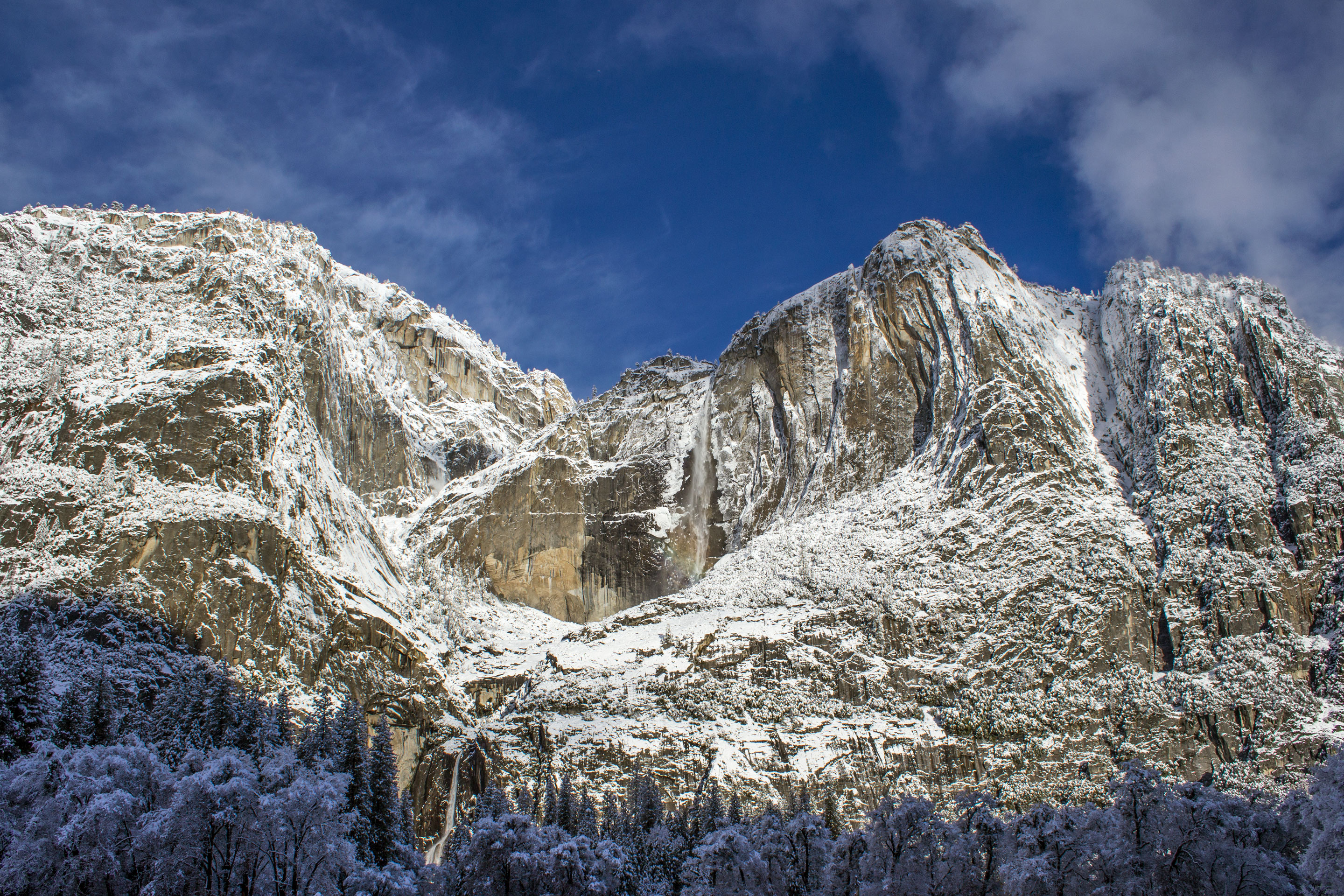
Two tall waterfalls flowing down snow covered granite walls.
YOSE · National Park
CA
Last updated
May 17, 2026

When to visit Yosemite.

Yosemite splits into two parks. Yosemite Valley is open year-round; the high country (Tioga Road, Glacier Point) opens between late May and early June, then closes with the first major storm in mid-November. The best overall trade-off is mid-September through early October — every high road is still open, smoke and crowds ease, and dry weather holds. NPS has announced that day-use vehicle reservations will NOT be required in 2026 — see access below.

Annual visits3.85M
BusiestAugust
QuietestJanuary
Years on file47
Photo · NPS / Cindy Jacoby · NPS source
Visiting Yosemite.

Pick your month.

Three independent signals per month — crowd, weather, and access. Tap any row to read the full Yosemite guide for that month. We deliberately do not combine these into a single "best month" number; different priorities point at different months.

Sourced · NPS + NOAA
Each score is 0–100
Green = good for visitor on that axis. Yellow = mixed. Orange/red = avoid for that reason. The word inside each chip is the answer; the line beneath is the data behind it.
Month Crowd Weather Access What that means
January
Quiet
21% of peak · 115K visits
Harsh
48°F / 29°F (9°C / -2°C) · 6.98″ precip
Partial
Composite access score · 50/100
Yosemite Valley open year-round. Chains often required in storms. Tioga and Glacier Point closed. Quietest month of the year.Read January →
February
Quiet
24% of peak · 129K visits
Rough
51°F / 30°F (11°C / -1°C) · 6.49″ precip
Partial
Composite access score · 50/100
Valley reflects in fresh snow. Horsetail Fall sunset glow window (mid- to late February, conditions-dependent). High country closed.Read February →
March
Quiet
25% of peak · 136K visits
Mixed
57°F / 34°F (14°C / 1°C) · 5.47″ precip
Partial
Composite access score · 55/100
Mariposa Grove Road usually reopens late month. Waterfalls start swelling as snowpack melts. Glacier Point and Tioga still closed.Read March →
April
Moderate
48% of peak · 256K visits
Ideal
63°F / 38°F (17°C / 3°C) · 3.17″ precip
Mostly open
Composite access score · 60/100
Tioga Road plowing begins (~April 15, NPS schedule). Waterfalls climbing toward peak. Valley fully operating; high country still closed.Read April →
May
Busy
71% of peak · 383K visits
Ideal
71°F / 45°F (21°C / 7°C) · 1.92″ precip
Mostly open
Composite access score · 75/100
Waterfall season peaks. Glacier Point Road typically opens late month. Tioga Pass opens late month in light-snow years; later in heavy-snow years.Read May →
June
Packed
95% of peak · 508K visits
Ideal
81°F / 51°F (27°C / 11°C) · 0.46″ precip
Full
Composite access score · 90/100
Tioga Pass usually opens by mid-month. All park roads reach full operation. High-country wildflowers; hot afternoons in the Valley.Read June →
July
Packed
100% of peak · 536K visits
Mixed
89°F / 57°F (32°C / 14°C) · 0.29″ precip
Full
Composite access score · 100/100
Peak month (effectively tied with August). Valley afternoons in the high 80s. Best dry-weather window in the high country.Read July →
August
Packed
100% of peak · 537K visits
Mixed
89°F / 57°F (32°C / 14°C) · 0.16″ precip
Full
Composite access score · 100/100
Peak crowds continue. Waterfalls a trickle. Wildfire smoke risk highest now. Half Dome cables in operation if installed.Read August →
September
Packed
88% of peak · 473K visits
Good
83°F / 51°F (28°C / 11°C) · 0.40″ precip
Full
Composite access score · 100/100
Best tradeoff month. Smoke risk eases after Labor Day. All roads still open. School-restart drop in the second half.Read September →
October
Busy
77% of peak · 413K visits
Ideal
71°F / 41°F (22°C / 5°C) · 1.56″ precip
Full
Composite access score · 100/100
Best weather month statistically (low precip, mild highs). Dogwoods and oaks color in the Valley.Read October →
November
Quiet
40% of peak · 216K visits
Good
56°F / 33°F (13°C / 0°C) · 4.05″ precip
Mostly open
Composite access score · 70/100
Tioga and Glacier Point typically close mid-month with the first major storm. Quieter Valley with crisp air.Read November →
December
Quiet
28% of peak · 149K visits
Harsh
46°F / 28°F (8°C / -2°C) · 5.60″ precip
Partial
Composite access score · 50/100
Valley winter season. Chains often required. Tioga and Glacier Point fully closed. Snow can shut entry roads during storms.Read December →
How these scores are computed (and why there's no combined "best month")

Crowd score

Formula: 100 − (this month's visits ÷ park's peak month visits) × 100. Each park scored against its own peak, not against other parks.

Source: NPS Visitor Use Statistics Data Package 2025, Recreation Visits (TRV), 5-year monthly mean (2021-2025). Reproduce these numbers on the NPS IRMA Stats portal.

Reading it: July at Yosemite reads 0 (peak). November reads 60 (nearly empty). A 50 means about half the park's peak crowd.

Weather score

Formula: weatherScore = round(max(0, min(100, dayComfort − precipPenalty − snowPenalty − freezePenalty))). The piecewise day-comfort function is continuous at every boundary.

  • Day comfort: tmax < 50°F → max(10, (tmax − 20) × 2) (cold tail); 50–60°F → 60 + (tmax − 50) × 4 (ramp to 100); 60–78°F → 100 (plateau); 78–85°F → 100 − (tmax − 78) × 5 (ramp to 65); > 85°F → max(30, 65 − (tmax − 85) × 5) (hot tail).
  • Precip penalty: max(0, prcpIn − 1.5) × 8 — kicks in above 1.5 in / month.
  • Snow penalty: snowIn × 2.5.
  • Night-freeze penalty: max(0, 32 − tmin) × 1.5 when tmin < 32°F.

Source: NOAA NCEI U.S. Climate Normals 1991-2020, station Yosemite Park HQ, CA (Yosemite Valley) (USC00049855, 4,018 ft).

Caveat: Yosemite Park HQ sits at 4,018 ft in Yosemite Valley — the destination for ~95% of visitors. The high country runs dramatically colder and snowier: Glacier Point (7,214 ft) is roughly 10°F colder; Tuolumne Meadows (8,600 ft) is 15-20°F colder with snowpack into June; Tioga Pass (9,945 ft) holds snow through July in heavy years. NCEI monthly snow normals at the Valley station are 0.0 — the Valley is snow-light by elevation, though any winter storm can bring temporary snow. Use these numbers for the Valley; assume a sharp drop for any trip planned into the high country.

Access score

Formula: For each named park road, count it open if its typical operating window covers that month. Score = round((sum of weights of open roads / sum of all weights) x 100). Where a park has a partial winter access mode, the profile documents that assumption in its access notes.

Route weights at Yosemite:

  • Day-use reservations: Not in effect for 2026
  • Yosemite Valley + year-round corridor: Open year-round
  • Tioga Road / Tioga Pass (CA-120 E): Open late May or June → sometime in November
  • Glacier Point Road: Open ~late May → mid-Nov
  • Mariposa Grove Road: Open spring → late fall
  • Entrance fees: Year-round
  • Lodging — concessioner (Aramark / Yosemite Hospitality): Year-round + summer-only mix
  • Half Dome cables: ~Late May → mid-Oct

Editorial methodology — the route weights themselves are author-curated, sourced from data/processed/operations/road_windows.csv and the park's own access caveats below the score table.

Caveat: The score reflects wheeled-vehicle road access only. Backcountry, hiking, lodging, shuttle, and other service availability are not directly included unless the park profile states otherwise.

Why no combined score?

A combined "best month" number forces a weighting — how much do you care about crowds vs. weather vs. access? Those weights are personal. A photographer optimizing for golden light weights differently than a parent locked to school break weights differently than a winter visitor with a 4WD. We show the inputs and let you decide. Use the per-month grid above to navigate to a deeper page.

Annual visits · 5-yr avg3.85M4,278,413 in 2025
Busiest monthAugust537K avg visits
Quietest monthJanuary5× thinner than August
Best tradeoffSeptemberCrowds drop, ops still full
For your Yosemite trip.

Pick your priority.

Crowd-free trails, full operations, or value-and-solitude. Each card points at a different month — pick the one that fits what you're actually after.

Source · NPS Recreation Visits
5-year monthly mean
If you want

Crowd-free trails

Mid-September → early October

Schools restart, smoke risk drops after Labor Day, and crowd levels ease while every high road is still open. The first major storm typically closes Tioga and Glacier Point in October or November (the date shifts with snowfall) — so this window is short but uniquely full-access. Dogwoods and big-leaf maple begin coloring in the Valley by early October.

Read the September deep-dive →
If you want

Full operations

Mid-June → mid-October

Tioga Road and Glacier Point Road are open. All in-park lodges (except Wawona Hotel, currently closed for assessment) run their full schedule. Plan trailheads at sunrise, expect hot Valley afternoons, and check current air quality if regional fires are active.

Read the July deep-dive →
If you want

Value & solitude

Mid-November → early April

Tioga and Glacier Point are closed. The Valley, Wawona, and the Big Oak Flat / Hetch Hetchy corridor stay open and plowed. Tire chains are commonly required after storms (R-2 condition). Waterfalls run thin until the spring melt resumes in late March.

Read the winter guide →
For families with kids · June / July / August

Locked to school break?

If you're traveling in summer, the smartest family windows are late June or the last week of August onward.

August is the data-defined peak month at Yosemite (5-year mean is slightly higher than July). Mid-July through mid-August is also when Valley afternoons run hottest, in the high 80s°F, and falls within California's broader summer-and-fall wildfire-smoke window. For families locked to school breaks, the better trade-offs are (a) late June, when waterfalls are still running strong and Tioga Pass has usually just opened (in heavy-snow years Tioga can open as late as July — check current road status before counting on the high country), or (b) the last week of August onward — depending on when your district restarts — as the U.S. school year ramps and visits begin easing into September. Yosemite's post-school-restart drop is real but more modest than Yellowstone's — roughly 12% in monthly mean — so don't expect an empty park, just a noticeably easier one. In-park lodges fill fast; booking is via Aramark / Yosemite Hospitality.

1

June

Waterfalls still strong (Yosemite Falls, Bridalveil, Vernal). Tioga Pass typically opens mid-month, unlocking Tuolumne. Wildflowers in the high country. Cooler Valley afternoons than July or August.
Late-snow years can delay Tioga and Glacier Point. River swimming dangerous early month (cold + high flow). Mosquitoes intense at lower elevations.
2

August

Full operations every district. Half Dome cable lottery is open (apply ahead via Recreation.gov). Last 10 days drop noticeably as families head home for the U.S. school restart.
Hottest Valley afternoons. Wildfire-smoke risk highest now. Waterfalls reduced to a trickle. Lodging tightest of the year.
3

July

All roads open. Longest daylight. High country fully accessible.
Absolute peak crowd of the year — effectively tied with August. Hot, dry, and smoke-prone. Parking fills quickly during the morning peak.
Getting there — airports and ground transport

Closest commercial gateway: Fresno Yosemite International (FAT) — ~2 hours to the South Entrance via CA-41 / Wawona. Other options: Mammoth Yosemite (MMH) for Tioga Pass entry in summer only, Reno-Tahoe (RNO) for Tioga Pass approach from the north, San Francisco (SFO) or Oakland (OAK) for the CA-120 / Big Oak Flat approach (~3.5-4 hours). From Sacramento via CA-140 / Merced is the lowest-elevation winter route. Rental car is effectively required — the YARTS regional bus serves the park from Merced, Mariposa, Sonora, Mammoth, and Fresno, but does not cover every itinerary.

Day-use reservations for 2026

NPS announced that day-use vehicle reservations will not be in effect for 2026. You do NOT need a separate permit to drive in. Wilderness permits (for overnight backpacking) and the Half Dome cables permit are separate and still required. Confirm current status on the NPS Yosemite reservations page.

Junior Ranger program

Yosemite offers age-tiered Junior Ranger booklets at any visitor center — free per NPS Yosemite (Yosemite Conservancy's Little Cub Handbook for younger children is a separate, paid track). Plan 2-4 hours of park activities. The walk to Lower Yosemite Fall and the short loop around Sentinel Bridge are the highest-ROI kid stops in the Valley.

Lodging lead time

In-park lodges (The Ahwahnee, Yosemite Valley Lodge, Curry Village, Housekeeping Camp, Tuolumne Meadows Lodge) book through Aramark / Yosemite Hospitality. White Wolf Lodge is closed for the 2026 season (NPS sewer rehabilitation). Summer-weekend inventory is the constraint — start watching the calendar a year ahead, and have backup dates. The Wawona Hotel is currently closed for assessment — don't plan around it without confirming reopening. Outside-the-park family bases that work: El Portal (CA-140, closest to Valley); Mariposa or Midpines (CA-140, low-elevation winter-friendly); Oakhurst (CA-41 south); Groveland (CA-120 west); Mammoth Lakes (Tioga Pass east, summer-only access).

Wildfire smoke risk

Summer and fall in California can carry heavy regional wildfire smoke, even when Yosemite itself isn't burning. Check AirNow.gov and the NPS Yosemite air-quality page for current conditions. In bad-smoke years viewpoints can be visibly hazed for days; June and post-Labor-Day September tend to be the lower-risk family windows.

Water safety with kids

The Merced River and waterfall pools look inviting and have caused most of Yosemite's swimmer drownings. Spring snowmelt makes the river dangerously cold and fast through June; never wade above a waterfall. NPS posts swim-safe vs. swim-no zones — follow them. Standard swim hole is at Sentinel Beach and Cathedral Beach late summer when flow is low.

Wildlife with kids — bears and black bears

Yosemite has a healthy black bear population (no grizzlies in California). NPS rules: stay at least 50 yards from bears in undeveloped areas; at least 25 feet from all other wildlife. Use the food storage lockers at every trailhead and campground — bear break-ins to cars are the #1 violation. NPS notes: never leave food, scented items, or coolers visible in vehicles, even in the Valley parking lots.

Altitude pacing for kids

Yosemite Valley sits at ~4,000 ft — easy for most kids. The high country jumps fast: Glacier Point is 7,214 ft, Tuolumne Meadows 8,600 ft, Tioga Pass 9,945 ft. Day-trip high-country drives are fine; if kids show fatigue, descend. Push water and ease into hikes on day one. Half Dome (8,842 ft) and Clouds Rest (9,926 ft) are full-day, altitude-aware expeditions — not first-day hikes.

For photographers · flexible calendar

The light, the window.

Yosemite's iconic light windows are February (Horsetail Fall), May-June (waterfalls), and October (color).

Yosemite's calendar for photographers is unusually narrow. Horsetail Fall's sunset glow is a roughly 10-day window in mid-to-late February when sun angle, water flow, and clear skies align — well-documented on the NPS Horsetail Fall page, including the parking-and-walk-in protocol Yosemite uses during the event. Waterfalls peak in May and June with snowmelt; by August most are a trickle. Valley dogwoods peak late April; big-leaf maples in the Merced Grove and Valley floor color in late October. Half Dome cables are installed in late May or early June and removed in mid-October — the iconic Half Dome summit shot has a single seasonal window.

Sunrise & sunset at the cardinal dates

DateSunriseSunset
March 21 (vernal equinox)7:00 AM7:11 PM
June 21 (summer solstice)5:37 AM8:24 PM
September 21 (autumnal equinox)6:46 AM6:57 PM
December 21 (winter solstice)7:10 AM4:43 PM
Times at Yosemite Valley HQ (37.75°N, 119.59°W). Source: U.S. Naval Observatory Rise/Set/Transit/Twilight Data. Pacific Time (PDT March-November; PST December-February). The granite walls of the Valley itself can hide the sun for 30-60 minutes after the published sunrise — plan accordingly.
Horsetail Fall sunset glow
Mid-to-late February (~10-day window)

Requires water in the fall (snowmelt-fed, conditions-dependent), a clear western horizon, and the right sun angle. NPS runs a managed parking + walk-in protocol during the event — see the NPS Horsetail Fall page for current rules.

Yosemite Falls, Bridalveil, Vernal at full flow
May and June

Snowmelt-driven peak. By late July most falls have dropped sharply; Yosemite Falls can run dry by August in low-snow years.

Valley dogwoods in bloom
Mid-to-late April (~2 weeks)

Pacific dogwood understory through the Valley, contrasting against the granite. Earlier in warm springs; later in cold ones.

Big-leaf maple and dogwood fall color
Late October to early November

Color peaks on the Valley floor. Higher elevations (Glacier Point Road, Tioga) color earlier in early October but those roads close with the first major storm.

Half Dome with cables
~Late May to mid-October

Cables installed when snow clears and removed before winter. Permit lottery required to climb.

Air quality & smoke check: NPS Yosemite air quality

Yosemite crowds, by month.

Average recreation visits at Yosemite National Park, calendar order. Each bar is normalised to the park's peak month — taller bar, busier month. Tap a row to read the park-month page.

Statistic · TRV
Window · 5 years
Month Crowd vs peak month Avg visits (5-yr) % of peak Band What's actually happening
JanuaryJan
115,014↑ 135,684 latest 21/ 100 Low Yosemite Valley open year-round. Chains often required in storms. Tioga and Glacier Point closed. Quietest month of the year.
FebruaryFeb
129,412↓ 120,601 latest 24/ 100 Low Valley reflects in fresh snow. Horsetail Fall sunset glow window (mid- to late February, conditions-dependent). High country closed.
MarchMar
136,081↑ 155,758 latest 25/ 100 Low Mariposa Grove Road usually reopens late month. Waterfalls start swelling as snowpack melts. Glacier Point and Tioga still closed.
AprilApr
256,083↑ 297,621 latest 48/ 100 Moderate Tioga Road plowing begins (~April 15, NPS schedule). Waterfalls climbing toward peak. Valley fully operating; high country still closed.
MayMay
383,092↑ 454,491 latest 71/ 100 High Waterfall season peaks. Glacier Point Road typically opens late month. Tioga Pass opens late month in light-snow years; later in heavy-snow years.
JuneJun
507,617↑ 584,333 latest 95/ 100 Peak Tioga Pass usually opens by mid-month. All park roads reach full operation. High-country wildflowers; hot afternoons in the Valley.
JulyJul
535,577↑ 616,551 latest 100/ 100 Peak Peak month (effectively tied with August). Valley afternoons in the high 80s. Best dry-weather window in the high country.
AugustAug
537,020↑ 594,060 latest 100/ 100 Peak Peak crowds continue. Waterfalls a trickle. Wildfire smoke risk highest now. Half Dome cables in operation if installed.
SeptemberSep
472,983↑ 487,733 latest 88/ 100 Peak Best tradeoff month. Smoke risk eases after Labor Day. All roads still open. School-restart drop in the second half.
OctoberOct
412,607↑ 445,779 latest 77/ 100 High Best weather month statistically (low precip, mild highs). Dogwoods and oaks color in the Valley.
NovemberNov
216,341↑ 234,709 latest 40/ 100 Moderate Tioga and Glacier Point typically close mid-month with the first major storm. Quieter Valley with crisp air.
DecemberDec
148,661↑ 151,093 latest 28/ 100 Low Valley winter season. Chains often required. Tioga and Glacier Point fully closed. Snow can shut entry roads during storms.
September caveat

Yosemite's September monthly mean (~88% of August) hides a meaningful split. Early September still carries Labor Day weekend and the back end of summer crowds; from roughly the second week onward, U.S. schools have restarted and weekday traffic eases noticeably. We don't yet publish weekly NPS counts on this page; when we do, the September curve will show the second-half drop explicitly. Treat the 'best week' recommendation as observational, not yet chart-backed at weekly resolution.

Yosemite weather, by month.

NOAA climate normals 1991-2020 for the station closest to park headquarters. Use it as a planning floor, not a forecast — and read the elevation caveat below.

NOAA NCEI · 1991-2020
Station · Yosemite Park HQ, CA (Yosemite Valley)
Month Temperature range (°F) High Low Precip (in) Snow (in) Verdict
January
48°°F high 29°°F low 6.98inches 0.0inches Cold
February
51°°F high 30°°F low 6.49inches 0.0inches Cold
March
57°°F high 34°°F low 5.47inches 0.0inches Shoulder
April
63°°F high 38°°F low 3.17inches 0.0inches Shoulder
May
71°°F high 45°°F low 1.92inches 0.0inches Warm
June
81°°F high 51°°F low 0.46inches 0.0inches Hot
July
89°°F high 57°°F low 0.29inches 0.0inches Hot
August
89°°F high 57°°F low 0.16inches 0.0inches Hot
September
83°°F high 51°°F low 0.40inches 0.0inches Hot
October
71°°F high 41°°F low 1.56inches 0.0inches Warm
November
56°°F high 33°°F low 4.05inches 0.0inches Shoulder
December
46°°F high 28°°F low 5.60inches 0.0inches Cold
Source: NOAA NCEI U.S. Climate Normals 1991-2020 · station Yosemite Park HQ, CA (Yosemite Valley) (USC00049855, 4,018 ft).
Elevation caveat: Yosemite Park HQ sits at 4,018 ft in Yosemite Valley — the destination for ~95% of visitors. The high country runs dramatically colder and snowier: Glacier Point (7,214 ft) is roughly 10°F colder; Tuolumne Meadows (8,600 ft) is 15-20°F colder with snowpack into June; Tioga Pass (9,945 ft) holds snow through July in heavy years. NCEI monthly snow normals at the Valley station are 0.0 — the Valley is snow-light by elevation, though any winter storm can bring temporary snow. Use these numbers for the Valley; assume a sharp drop for any trip planned into the high country.
Verified · NOAA NCEI direct

Year over year.

Annual recreation visits at Yosemite National Park, 2015–2025. Hover any bar to compare; the chart is the same record the agency itself publishes.

Source · NPS IRMA Stats
Statistic · Recreation Visits
4.15M
5.03M
4.34M
4.01M
4.42M
2.27M*
3.29M
3.67M
3.90M
4.12M
4.28M
2015
2016Record · NPS Centennial year
2017
2018
2019
2020Pandemic · spring closure + day-use cap
2021Day-use reservation system in effect
2022Reservations + Washburn Fire
2023Heavy snow · Tioga opened late July
2024
2025
*Affected by COVID-19 closures and reduced operations.
Latest annual4,278,413
5-year mean3,850,488
11-year record high5,028,868 in 2016

Access & operations.

Roads, lodges, entrances. The seasonal pattern that turns a good plan on paper into a workable one in the field. Verify with NPS before you travel — these change.

Independent summary
Last updated · May 17, 2026
Not in effect for 2026

Day-use reservations

NPS announced Yosemite will not use a day-use vehicle reservation system in 2026 — entry by vehicle does not require a permit. The park is instead managing summer congestion with real-time traffic, parking, and arrival-window operations. Verify on the NPS Yosemite reservations page before your trip.

Open year-round

Yosemite Valley + year-round corridor

Yosemite Valley is reached year-round by El Portal Road (CA-140 from Merced), Wawona Road (CA-41 from Fresno), and Big Oak Flat Road (CA-120 W from the Bay Area). All three are plowed and patrolled in winter. Tire chains are commonly required after storms (R-2 condition) — bring chains regardless of vehicle type.

Open late May or June → sometime in November

Tioga Road / Tioga Pass (CA-120 E)

Plowing begins around April 15. Typical opening is late May to late June depending on snowpack; in heavy-snow years (e.g., 2017, 2023) it has opened in mid-July. Closes for winter with the first major storm in November.

Open ~late May → mid-Nov

Glacier Point Road

Opens late May to early June after plowing; closes in October or November (the date shifts with snowfall). The road has had construction-related delayed openings in recent years — verify with NPS before booking a Glacier Point trip.

Open spring → late fall

Mariposa Grove Road

Giant sequoia access. Reopens in spring after plowing and closes in late fall — exact dates shift year to year with snowpack.

Year-round

Entrance fees

$35 per vehicle for a 7-day pass (covers vehicle + all passengers). $70 for the Yosemite-only annual pass. The $80 America the Beautiful annual pass covers entry to all U.S. national parks. Verify current rates on the NPS Yosemite fees page.

Year-round + summer-only mix

Lodging — concessioner (Aramark / Yosemite Hospitality)

In-park lodges are booked through Aramark / Yosemite Hospitality. The Ahwahnee, Yosemite Valley Lodge, and Curry Village operate year-round. Housekeeping Camp is seasonal (approximately mid-April to early October). Tuolumne Meadows Lodge and the High Sierra Camps are summer-only. White Wolf Lodge is currently closed for the 2026 season (NPS sewer rehabilitation). The Wawona Hotel is currently closed for structural assessment — confirm reopening status before counting on it.

~Late May → mid-Oct

Half Dome cables

The cable route is installed late May or early June and removed in mid-October. A permit lottery is required to climb the cables — apply via the Recreation.gov Half Dome permit page.

For families with kids · year-round

Junior Ranger.

Yosemite's Junior Ranger program lets kids work through an age-appropriate booklet, complete activities tied to the Valley and beyond, attend a ranger-led activity when one's running, and earn a wooden badge. Per the NPS Yosemite Junior Ranger page, the Junior Ranger handbook is currently free at all park visitor centers. A separate Little Cub Handbook for younger children (around ages 3-6) is published by the Yosemite Conservancy and sold for a small price at visitor-center bookstores — confirm at the desk on arrival.

Yosemite Junior Ranger — age-tiered booklets at any visitor center.
Age tiers
  • Ages 3-6 (Little Cub Handbook, published by Yosemite Conservancy) — Shorter activity set; drawing, observation, simple checklists. Sold separately at visitor-center bookstores.
  • Ages 7-9 — Standard booklet with kid-paced reading and Valley activities.
  • Ages 10-12 — Standard booklet with deeper writing and Valley + beyond activities.
  • Teens — Older kids can also work the standard booklet or ask about the Yosemite Junior Cave Scientist add-on.
CostFree for the standard Junior Ranger handbook per the NPS (Yosemite Conservancy's Little Cub Handbook for younger kids is sold for a small price). Confirm at the desk on arrival.
Where to get itAny Yosemite visitor center: Valley Welcome Center, Wawona, Tuolumne Meadows (summer), Big Oak Flat (summer).
Time to complete2-4 hours of in-park activities; can be spread across multiple days.
Badge ceremonyReturn the completed booklet to any visitor center for the swearing-in and wooden badge.
Visiting Yosemite.

Older travelers, RVs, and mobility.

Yosemite is one of the more accessible major parks because the Valley shuttle covers the highest-value sights with no driving and many of the iconic stops are paved short walks. The constraints to plan around are RV length on Tioga Road, chain laws in winter, and the Wawona Hotel currently being closed.

Audience-segmented
Senior & mobility-aware

Retirees, RV travelers, and visitors with mobility considerations.

Senior Pass + America the Beautiful Pass

The America the Beautiful Senior Pass is $20/year for the Annual Senior Pass or $80 for the Lifetime Senior Pass (U.S. citizens / permanent residents 62+). It covers entry to every national park, including Yosemite. If both partners are 62+ only one pass is needed per vehicle. The standard Annual Pass ($80) covers everyone else for a year and is the most-recommended option if you'll visit 2+ parks in a year.

Valley shuttle and accessible viewpoints

The free Valley shuttle (operated by Aramark for NPS) is fully accessible and reaches the Visitor Center, Lower Yosemite Fall, Yosemite Village, Curry Village, and most Valley trailheads. The walk to Lower Yosemite Fall is short and paved. Tunnel View, Bridalveil Fall (accessible portion), and the El Capitan Meadow pullouts are drive-up. Glacier Point (in season) is reached by car or guided bus and has a short paved walk to the viewpoint.

RV access — length limits and roads

Yosemite Valley campgrounds (Upper Pines, Lower Pines, North Pines) accept most RVs; Camp 4 is tent-only and walk-in. Reservations through Recreation.gov. For road-by-road length limits, hookup status, and dump-station details, see the dedicated RV section.

Lodging-first option (skip the campground)

Year-round Valley lodging: The Ahwahnee (historic hotel), Yosemite Valley Lodge (modern, near Lower Yosemite Fall), Curry Village (cabins + tent cabins, lower-priced). Housekeeping Camp is seasonal (mid-April to early October, not available in winter). All bookable via Aramark / Yosemite Hospitality. The Wawona Hotel is currently closed for assessment. Valley Lodge is the most-recommended for shorter walks to facilities; The Ahwahnee for the fully-served experience.

Distances and pacing

Yosemite covers 1,189 square miles, but the highest-value Valley sights are concentrated in a 7-mile loop. From the Valley to Glacier Point is ~1 hour by car (in season). To Mariposa Grove: ~1 hour via Wawona. To Tuolumne Meadows: ~1.5 hours via Tioga (summer only). Plan one major district per day. The Valley shuttle removes most parking stress in summer and is the recommended way to move around the Valley.

For RV travelers · length matters

RV & big-rig.

No full hookups inside Yosemite, Valley campgrounds cap at 35 ft, Tioga is not for big rigs.

Yosemite has no full-hookup sites inside the park. Upper Pines (Valley) accepts RVs up to 35 ft and trailers up to 24 ft; Lower Pines and North Pines accept RVs up to 40 ft and trailers up to 35 ft. Tioga Road is the road that catches first-time RV visitors — the long climb to Tioga Pass (9,945 ft), tight turns at Olmsted Point, and limited high-elevation parking at Tuolumne Meadows make it difficult for large rigs and anything towing, though the NPS does not publish a specific length limit. Glacier Point Road limits anything past Sentinel Dome to RVs 30 ft and shorter per the NPS Yosemite RV page. For full hookups you'll need to base in El Portal, Mariposa, Groveland, or Oakhurst and day-drive in.

RV length limits by road

Where your rig fits (and doesn't)

  • Upper Pines Campground (Valley, year-round)Max 35 ft — RVs up to 35 ft; trailers up to 24 ft. Camp 4 (Valley) is tent-only and walk-in.
  • Lower Pines & North Pines Campgrounds (Valley, seasonal)Max 40 ft — RVs up to 40 ft; trailers up to 35 ft. Not every site can accommodate the maximum length — confirm site details on Recreation.gov.
  • Tioga Road (CA-120 E)Advisory — The NPS does not publish a Tioga Road length limit, but limited high-elevation parking at Tuolumne Meadows and Olmsted Point, tight turns, and steep grade make it challenging for large rigs and anything towing. Verify current restrictions on the NPS RV page before bringing a big rig.
  • Glacier Point RoadMax 30 ft — RVs over 30 ft are restricted past Sentinel Dome / at Glacier Point itself.
  • Mariposa Grove RoadAdvisory — NPS limits vehicles to 25 ft max length and prohibits trailers. During operating season the road is also restricted to the free shuttle (and ADA-placard vehicles) from the Mariposa Grove Welcome Plaza.
  • Hetch Hetchy RoadMax 25 ft — Narrow, winding spur. No trailers; vehicles over 25 ft prohibited.
In-park hookups

Full hookups inside the park

None — Yosemite has no full-hookup sites. The closest in-park option is the Valley campgrounds with no hookups; for water/sewer/electric, base outside the park.

Dump stations

Where to dump tanks

Upper Pines (Valley, year-round), Wawona (summer), and Tuolumne Meadows (summer, when Tioga is open). Confirm seasonal status on Recreation.gov.

Outside-the-park

Nearby RV parks

Leave the rig parked

Reaching signature sights without the RV

Park the rig outside the park (El Portal, Mariposa, Groveland, or Oakhurst) and ride YARTS into the Valley — YARTS runs from Merced, Mariposa, Sonora, Mammoth (summer only via Tioga), and Fresno and stops at Valley locations. YARTS does not serve Glacier Point. Once in the Valley, the free year-round Valley shuttle covers the highest-value sights (Lower Yosemite Fall, Curry Village, Yosemite Village, Happy Isles trailhead). Glacier Point is reachable in summer by the Aramark Glacier Point Tour bus (separate ticket; one-way option available).

Visiting in winter · November → April

Driving in winter?

In winter, Yosemite Valley is open year-round — but chains are commonly required, even with AWD.

From mid-November through early April, Tioga Road and Glacier Point Road are closed to wheeled vehicles. Yosemite Valley remains open year-round and is reached by three plowed routes: El Portal Road (CA-140 from Merced, lowest elevation and most reliable in storms), Wawona Road (CA-41 from Fresno, crosses ~6,200 ft so closes briefly in storms), and Big Oak Flat Road (CA-120 W from the Bay Area, crosses ~6,200 ft and closes more often in storms). Once in the Valley, the Valley loop, El Capitan Picnic Area, and the road to Mirror Lake are open. Wawona, Hetch Hetchy, and the Mariposa Grove shuttle (when seasonal) are reachable from the southern side.

Access mode

What moves in winter

Yosemite has no snowcoach or snowmobile operations. The Badger Pass / Yosemite Ski Area (operated by Aramark) opens for downhill skiing and snowshoeing in mid-December if snowpack allows, accessed from the Glacier Point Road plowed turnoff. Cross-country skiing and snowshoeing run from Badger Pass and Crane Flat.

Season / status check

Confirm before the drive

Not applicable in Yosemite. The winter ops here are Valley-based — Yosemite Ski & Snowboard Area at Badger Pass typically operates mid-December through late March or early April if snowpack allows; verify current status with Aramark / Yosemite Hospitality before booking.

Your vehicle

Road-ready plan

The California Highway Patrol and NPS enforce chain controls. R-1: chains or snow tires required (light vehicles under 6,000 lbs with snow tires on at least the drive wheels are exempt from chains). R-2: chains required on all vehicles except 4WD/AWD with snow-tread tires on all four wheels. R-3: chains on every vehicle, no exceptions. Pack chains regardless of vehicle type — chain-control checkpoints turn back vehicles without them, and rental cars are not exempt.

Lodging

Where the trip anchors

Year-round in-park lodging: The Ahwahnee, Yosemite Valley Lodge, and Curry Village — all bookable through Aramark / Yosemite Hospitality. The Ahwahnee runs its Bracebridge Dinner in late December (Aramark / Yosemite Hospitality). Housekeeping Camp is seasonal (typically mid-April to early October) and not available in winter. Wawona Hotel is currently closed for structural assessment — do not plan around it without confirming.

Where to base

Gateway towns

Best winter bases: El Portal, CA (right on CA-140, lowest elevation, best storm-day access), Mariposa, CA (~30 mi west on CA-140), Oakhurst, CA (CA-41 south, more lodging variety), or Groveland, CA (CA-120 west, for the Big Oak Flat side). Avoid Mammoth Lakes for winter Yosemite — Tioga Pass is closed.

How this page
is built.

Independent, reader-supported.
Not affiliated with or endorsed
by the National Park Service.

Crowd numbers on this page are the Recreation Visits column from the NPS Visitor Use Statistics Data Package, 2025. Monthly figures are five-year arithmetic means (2021-2025) against each park's own peak month. We do not compare parks against each other for the crowd score — only against themselves.

Weather numbers are NOAA NCEI U.S. Climate Normals 1991-2020, drawn from the Yosemite Park HQ, CA (Yosemite Valley) station (USC00049855). The station sits at 4,018 ft; the elevation caveat above the weather table explains where this misreads the higher districts.

Access notes are an independent summary of NPS operating posture. We do not republish NPS pages; we link them. Conditions change — confirm road status, reservation requirements, and lodging windows on https://www.nps.gov/yose/index.htm before travel.

Crowd sourceNPS Visitor Use Statistics Data Package
Crowd range1979-2025
Weather sourceNOAA NCEI Normals
Weather period1991-2020
Last-mile check
The Almanac Mailing

The next Yosemite
window, in your inbox.

One email a month. The park to point at, the week to book, the trail that's about to fill up. No sponsorships, no affiliate pushes. Unsubscribe in a click.

One email per month. We file your address with care.