Lower Yosemite Fall routes differ
Use the eastern route for wheelchair access when clear of snow and ice. Restrooms and the drinking fountain are on the western trail.
Yosemite National Park accessibility offers short paved Valley routes and roadside views, with different limits at each stop. Use the eastern Lower Yosemite Fall approach for wheelchair access; the western side has the restrooms and a steeper climb. Mirror Lake's last approach is steep, even though the road is paved. Valley shuttles have wheelchair lifts, and disability placards permit specific drives to Mirror Lake, Happy Isles and Mariposa Grove when those roads allow access.
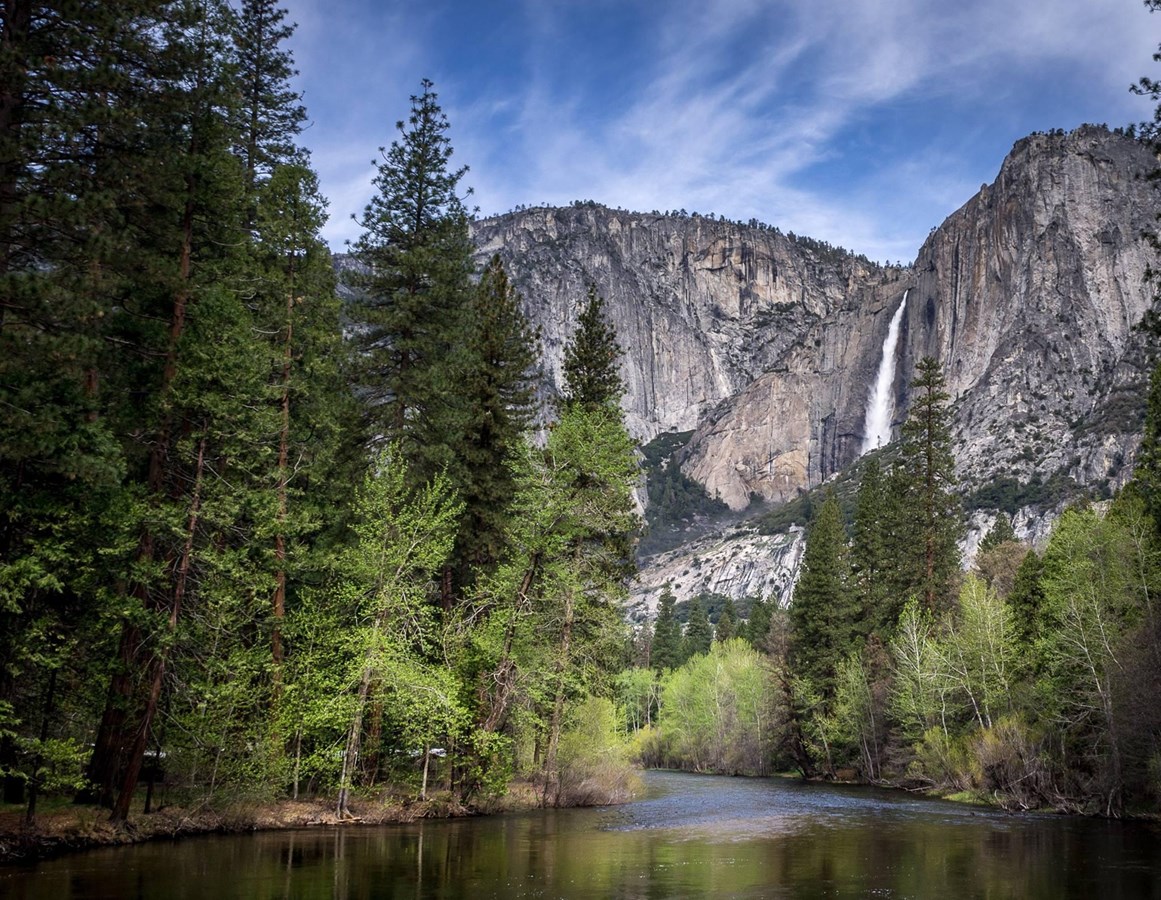
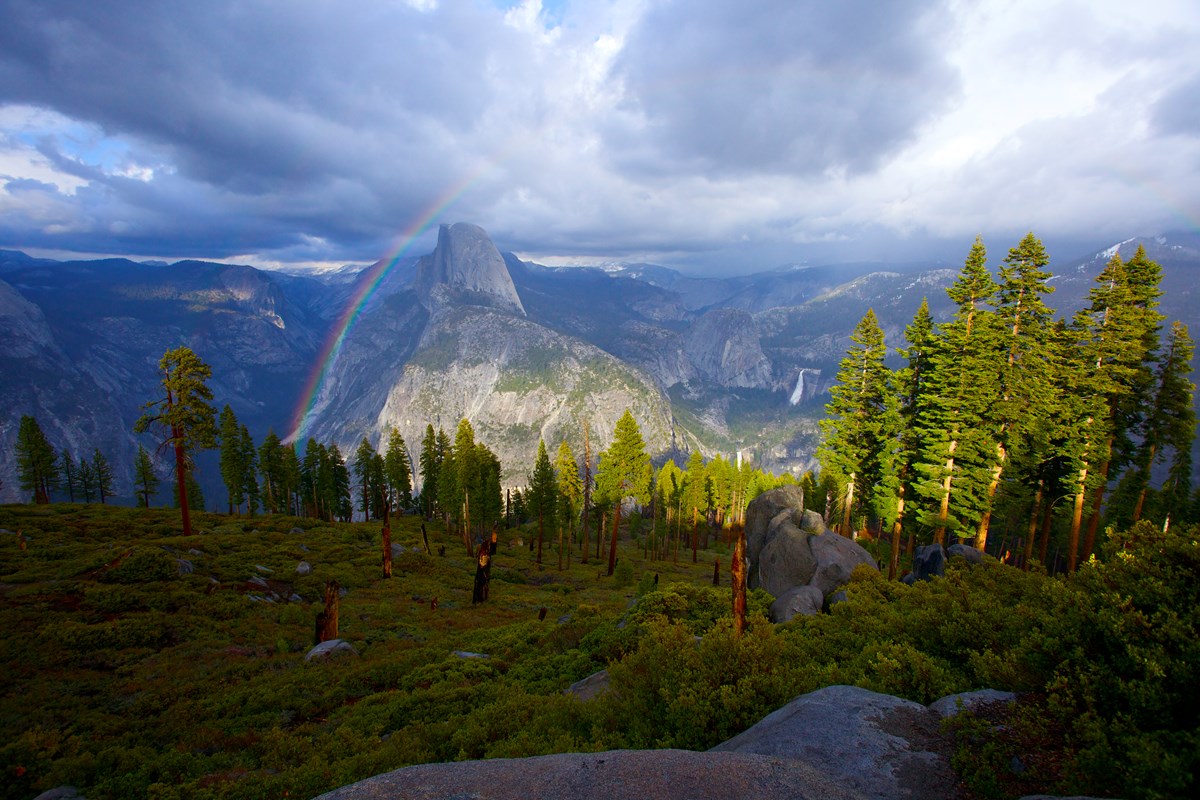
Match the approach to the destination. The accessible side of a loop may not have its restrooms, and pavement can still be steep.
| Area | Accessible route or view | Slopes, steps and other limits |
|---|---|---|
Lower Yosemite Fall and Cook's Meadow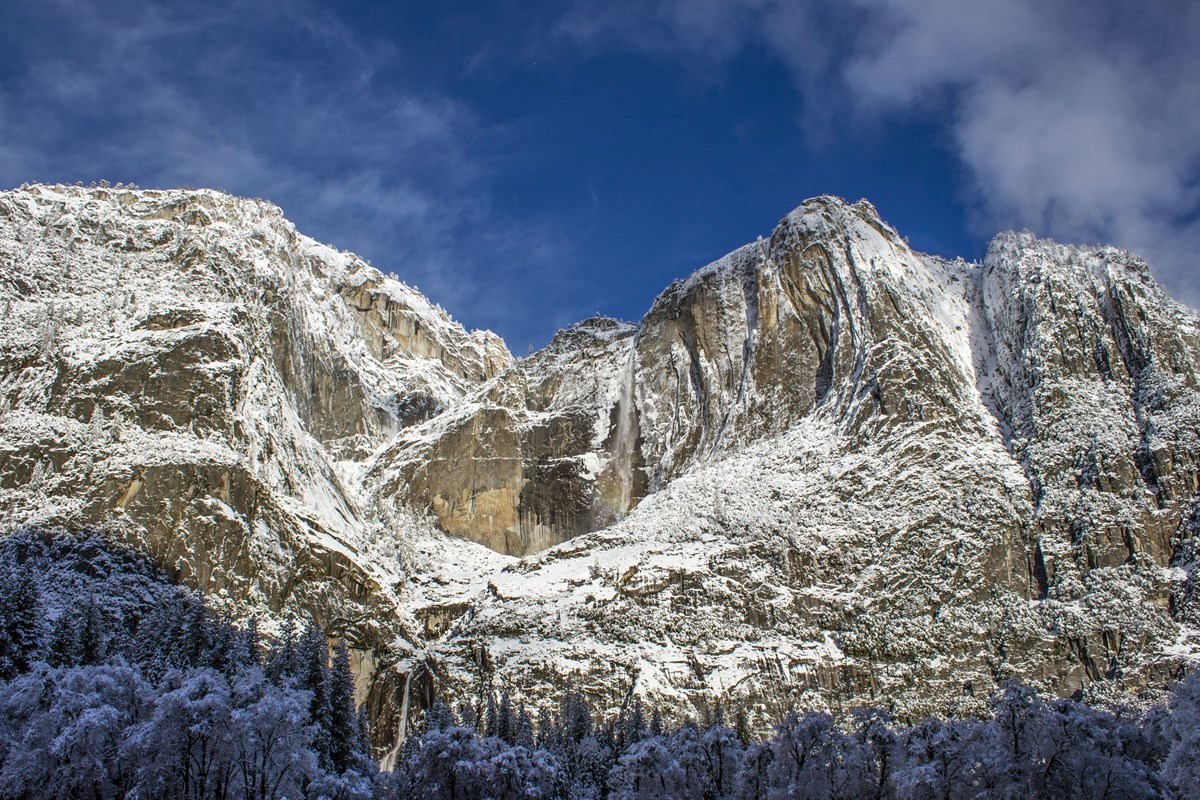 | Two 1-mile loops that meet at shuttle stop #6. NPS says the eastern portion of the paved Lower Yosemite Fall loop is wheelchair accessible when not covered in ice or snow. Cook's Meadow, which starts at the Yosemite Valley Visitor Center (stop #5), is flat and wheelchair accessible when not covered in snow. | There is no parking at the Lower Yosemite Fall trailhead; park at Yosemite Village or Yosemite Falls parking. Its restrooms and drinking fountain are on the western trail only, and the short climb to the footbridge on that side gets icy in winter. |
Bridalveil FallDirections to Bridalveil Fall parking lotBridalveil Fall parking lot Use designated public parking. Check park access and vehicle restrictions before travel. | A paved trail leads from the parking area to the base of the fall, which flows all year. NPS says the western trail to the base is wheelchair accessible. | No shuttle goes here, so you have to drive. The lot often fills quickly in summer, and traffic jams are common getting in and out. |
| Mirror Lake | A one-mile paved road from shuttle stop #17 leads to the lake view, and NPS says it is easy to walk. With a disability placard you may drive it at up to 15 mph with hazard lights on, to two designated accessible parking spaces. | The last 1,000 feet up to the lake slope from 6.6% to 10.6%, and you share the road with bicyclists and hikers. The vault toilets, about 0.5 mile in and at the end of the pavement, aren't described as accessible. |
| Happy Isles Art and Nature Center | The building is wheelchair accessible and has tactile exhibits on Yosemite's natural history. With a disability placard you can drive Happy Isles Loop Road to limited designated accessible parking nearby. | There is no other parking close by; everyone else walks from shuttle stop 16. The center is open April through October, 9 am to 4 pm. |
| Mariposa Grove | Placard vehicles can drive Mariposa Grove Road at 25 mph to accessible parking at the arrival area. The arrival area and the 0.3-mile Big Trees Loop, flat pavement and boardwalk, are wheelchair accessible. You can drive on to the Grizzly Giant accessible parking, where a 0.13-mile wheelchair-accessible section of trail reaches the Grizzly Giant and California Tunnel Tree. | The road is closed approximately November to April. The bronze tactile exhibit can be too hot to touch in hot weather, and drinking water at the arrival area is summer only. |
| Glacier Point | A 300-yard paved switchback trail runs from the main parking lot to the overlook. The restrooms, snack bar, and gift shop are accessible, there is designated accessible parking, and a bronze tactile relief model sits on the terrace below the gift shop. | It's 30 miles, about an hour's drive, from Yosemite Valley or Wawona, and Glacier Point Road is closed to cars from approximately November through May. |
| Tunnel View | Designated accessible parking. You can see the view from the parking area or take a short paved walk to the viewing area, which has a bronze tactile model of Yosemite Valley. | NPS lists no restroom here. |
Tioga Road: Olmsted Point and Tenaya Lake | At Olmsted Point the view is visible from the parking lot and from paved, wheelchair-accessible walkways beside it, with a bronze relief tactile model. Tenaya Lake's east end has designated accessible parking, an accessible vault toilet, and a paved accessible path to open lake views. | The trail out to Olmsted Point itself is not wheelchair accessible. Tioga Road is closed from approximately November through May. |
Mirror Lake has a measured steep final approach. NPS does not provide comparable percentage grades for every route on this page.
| Route or section | Grade stated by the official source |
|---|---|
| Mirror Lake road, last 1,000 ft, lowest | 6.6% |
| Mirror Lake road, last 1,000 ft, steepest | 10.6% |
The lowest and highest slope NPS gives for the last 1,000 feet of the paved road up to Mirror Lake, from the NPS Mirror Lake page. It is the only measured grade Yosemite publishes for an accessible route. No Yosemite page states a reference grade, so the chart draws none.
Plan parking and restrooms separately from the view. Lower Yosemite Fall has no trailhead parking and puts its restrooms on the western side.
Use the eastern route for wheelchair access when clear of snow and ice. Restrooms and the drinking fountain are on the western trail.
There is no parking at the Lower Yosemite Fall trailhead. Happy Isles has only limited designated accessible parking.
NPS gives restroom details place by place rather than in one list. The ones it calls accessible are Glacier Point's restrooms and the vault toilet at Tenaya Lake's east end, and Shuttle Stop #1 at Yosemite Village Parking lists a restroom and wheelchair access among its amenities. At Lower Yosemite Fall, the restrooms and drinking fountain are only along the western trail, so use them before you roll the accessible eastern side. Mirror Lake has vault toilets about 0.5 mile in and at the end of the paved road, and the Mariposa Grove arrival area has flush toilets in summer and vault toilets in winter. Those pages don't say whether the toilets are accessible, so ask at a visitor center. Parking is the other thing to plan: Lower Yosemite Fall has none at the trailhead, Happy Isles has only limited accessible spaces, and the Bridalveil Fall lot fills quickly in summer (NPS Lower Yosemite Fall page).
Valley shuttles have lifts and tie-downs. Placard road access and equipment rentals can help, but each has its own limits.
NPS lists lifts and tie-downs on all Valley shuttles and a maximum chair size of 24 inches wide by 46 inches long.
The Yosemite Valley Lodge bike stand lists limited wheelchairs and motorized scooters. Call ahead to confirm the equipment and price.
The free Valley shuttles run 7 am to 10 pm daily, and no ticket is needed. NPS says every shuttle has wheelchair lifts and tie-downs, and the largest wheelchair it takes is 24 inches wide by 46 inches long. Wheelchairs board first, and drivers will help you on and off or tell you when your stop comes. The Valleywide Shuttle runs about every 22 to 32 minutes and the East Valley Shuttle about every 18 to 22 (NPS shuttle stop page). Bridalveil Fall has no shuttle service.
A disability placard opens roads that are closed to other private cars. Happy Isles Loop Road leads to limited accessible parking near the Art and Nature Center. You may drive to Mirror Lake at up to 15 mph with hazard lights on. On Mariposa Grove Road you drive at 25 mph to the arrival area and on to the Grizzly Giant accessible parking, any time the road is open for the season (NPS Mariposa Grove page). The park's Accessibility Guide, last updated in May 2022, says a temporary placard is available at entrance stations and visitor centers if you're temporarily disabled or left yours at home. The guide is old, so confirm that at the gate.
The Yosemite Valley Lodge bike stand rents a limited number of wheelchairs and motorized scooters, plus tandem and hand-crank bicycles, and you can reserve them ahead at 209/372-1208 (NPS bike stand page). Bikes for people with disabilities are the only bikes there you can reserve. NPS says bicycle rentals run daily spring through fall, conditions permitting, and it doesn't list rental prices.
You don't have to drive yourself. The concessioner's bus and tram tours, including the Valley Floor Tour of about 2 hours, leave daily from Yosemite Valley Lodge. If you need ADA accommodations, ask on your reservation before you arrive so seats can be arranged for wheelchair access (operator tours page). YARTS buses into the park have ADA accessible seating and discounted fares for ADA eligible passengers.
U.S. citizens and residents with a permanent disability get the Access Pass free, and our Yosemite fees page has the details.
Tunnel View offers a view from the parking area. Glacier Point and Tioga Road destinations depend on seasonal road access.
Some of Yosemite's biggest views need almost no walking. At Tunnel View you can see the valley from the parking area. Glacier Point is about an hour from the Valley, and its paved path ends at the rail. On Tioga Road, the Olmsted Point view is right beside the lot, and Tenaya Lake's east end has a paved path to the water views. Glacier Point Road and Tioga Road both close to cars from approximately November through May. Our Tioga Road page covers that road, and Yosemite road closures has the rest. Hetch Hetchy Road is open all year, but only from sunrise to sunset. During the February Horsetail Fall viewing restrictions, NPS lets placard vehicles drive to El Capitan Picnic Area and park in turnouts on the north side of Northside Drive (NPS Horsetail Fall page).
Deaf Services, tactile models and adapted visitor materials support different needs. Allow time to arrange program interpreting.
The park offers free sign language interpreting and assistive listening for park programs. Allow two weeks to arrange requests.
Tactile models sit at several major viewpoints. NPS also provides an adapted Junior Ranger handbook and a Valley visual guide for people with aphasia.
Yosemite's Deaf Services Program offers sign language interpreting and assistive listening devices free for all park programs. Email the program with your request and allow two weeks to set it up. Its FAQ videos are in American Sign Language with transcripts or captions (NPS Deaf Services page). For blind and low-vision visitors, the park brochure comes as a Braille file, and audio description for it is in the UniDescription app for iOS and Android. Bronze tactile models sit at Tunnel View, Glacier Point, Olmsted Point, and the Mariposa Grove arrival area, and the Happy Isles Art and Nature Center has tactile exhibits.
The NPS accessibility page also links a Visual Guide to Visiting Yosemite Valley for People with Aphasia, and an adapted Junior Ranger Handbook for children with diverse communication, learning, motor, or sensory needs who have trouble using speech or writing tools. The park's full Accessibility Guide dates from May 2022, so check anything time-sensitive in it.
Service dogs are legally allowed anywhere visitors can go. Emotional support, therapy, and companion animals, and service animals in training, are not service animals and must follow the pet rules (NPS pets page). Wildlife safety is on our Yosemite with kids page.
NPS lists accessible campsites by campground; the concessioner lists accessible lodging without room counts. Ask for the features you need when booking.
NPS lists 58 accessible campsites across 11 campgrounds in its tentative 2026 table. Tuolumne Meadows has the most (13), then Upper Pines (10) and Crane Flat (7). Lower Pines and North Pines have 5 each; Wawona, Tamarack Flat, and Porcupine Flat have 4 each; Camp 4, White Wolf, and Yosemite Creek have 2 each. Hodgdon Meadow and Bridalveil Creek have none. Upper Pines, Camp 4, Wawona, and Hodgdon Meadow are open all year, while Tuolumne Meadows has a short summer season that depends on high-country road and facility access. The table doesn't describe the sites' features, so ask when you book on our Yosemite camping page. For rooms, the concessioner, Yosemite Hospitality, says all its lodging meets ADA requirements and lists accessible rooms at The Ahwahnee, Yosemite Valley Lodge, Curry Village, Housekeeping Camp, White Wolf Lodge, and Tuolumne Meadows Lodge. It gives no room counts, so call about the room you need. It says the Wawona Hotel has no ADA accessible rooms. Not every lodge is open every season, so check the NPS lodging page for the ones running on your dates, and the NPS current conditions page for closed paths, restrooms and project work. The Ahwahnee and Yosemite Valley Lodge are open all year, and the other four are seasonal (NPS lodging page). The high-country pair, White Wolf Lodge and Tuolumne Meadows Lodge, keep the shortest seasons and sit on roads that close for winter, so read their operator pages for the dates and any closures before you book.
Start with nearby Valley stops before adding a high-country drive. Snow, waterfall season and elevation change the effort involved.
Start in Yosemite Valley, where the easy loops sit close together. Cook's Meadow is a flat 1-mile loop, and Lower Yosemite Fall is a 1-mile loop with about 50 feet of gain. They meet at shuttle stop #6, so one shuttle ride covers both. Shuttle Stop #1 has a covered shelter but very limited seating, so a folding stool helps if waiting is hard.
Plan around water and snow. Lower Yosemite Fall is loudest in spring and early summer, and it's often dry from late July or August through October. NPS calls the Valley paths accessible only when they're clear of snow or ice, and Mariposa Grove Road, Glacier Point Road, and Tioga Road close for winter. Valley campgrounds sit at 4,000 feet, while Tuolumne Meadows Campground is at 8,600, which matters if altitude tires you.
Save the drives for another day. Tunnel View and Glacier Point both put the view beside a paved path, and in summer Mariposa Grove is a placard drive from the South Entrance side. The best time to visit Yosemite page shows how busy each month gets.
Quick answers to the practical questions below.
At the Yosemite Valley Lodge bike stand. NPS says it has a limited number of wheelchairs and motorized scooters for rent, along with tandem and hand-crank bicycles, and you can reserve them ahead by calling 209/372-1208. NPS doesn't list prices or a separate rental season, so call before your trip.
It can be, with a plan. NPS makes no age-specific statement, but every Valley shuttle has a wheelchair lift, Cook's Meadow is a flat 1-mile loop, and Tunnel View and Glacier Point put big views beside short paved paths. With a disability placard you can drive to Mirror Lake, near the Happy Isles Art and Nature Center, and to the Mariposa Grove arrival area. Valley campgrounds sit at 4,000 feet.
An independent guide using official data. Not affiliated with or endorsed by the National Park Service.
The Braille brochure, audio description, adapted Junior Ranger Handbook, aphasia guide, and the guide's May 2022 date come from the NPS Yosemite accessibility page; the temporary placard from the NPS Accessibility Guide (2022); interpreting, listening devices, and ASL videos from the NPS Deaf Services page; service animal rules from the NPS pets page.
Shuttle hours, frequency, lifts, size limit, and Stop #1 amenities come from the NPS shuttle stop page; trail distances, surfaces, restrooms, parking, and seasons from the Lower Yosemite Fall, Cook's Meadow, Bridalveil Fall, and Mirror Lake Trail pages; the Mirror Lake grade and placard rule from the NPS Mirror Lake page; Happy Isles from the NPS Happy Isles page; Mariposa Grove from the NPS Mariposa Grove page; Glacier Point, Tunnel View, Olmsted Point, and Tenaya Lake from their NPS place pages (Glacier Point, Tunnel View, Olmsted Point, Tenaya Lake); rentals from the NPS bike stand page.
Accessible campsite counts, 2026 seasons and elevations come from the NPS campgrounds page; lodge seasons from the NPS lodging page; road seasons and the Mariposa Grove placard rule from the NPS road restrictions page; the 2026 Glacier Point and Tioga Road openings from the NPS Tioga Road page; the Horsetail Fall rule from the NPS Horsetail Fall page; the Access Pass from the NPS fees page.
Accessible rooms by lodge come from the Yosemite Hospitality accessibility page, and the lodge seasons from its own lodge pages; tour accommodations from the Yosemite Hospitality tours page; YARTS seating and fares from YARTS. The campsite total adds the NPS counts. The folding-stool tip and the day plan are our own.
Operational source check: September 11, 2026. Design and emphasized source review: 2026-10-23. A design review does not refresh every underlying record.