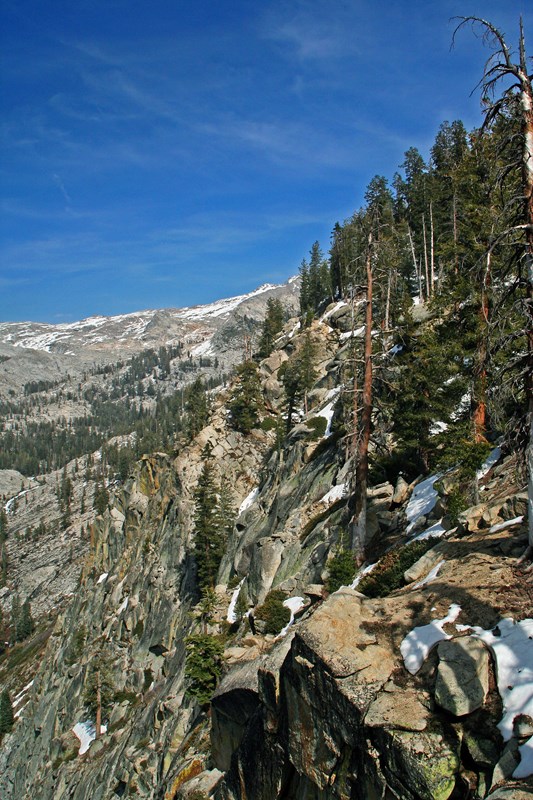
Which Sequoia sights are wheelchair accessible?
Use the accessible Sherman approach and compare nearby Giant Forest stops by slope and parking. Moro Rock and Crystal Cave have substantial barriers.
| Area | Accessible route or view | Slopes, steps and other limits |
|---|---|---|
General Sherman Tree | NPS calls the trail wheelchair accessible: a paved, slightly sloped path about 500 feet long past several named sequoias, with benches and exhibits, some in large type with good contrast. The Sherman Tree Accessible Parking Area and Trailhead has accessible parking, accessible restrooms, and benches. | In summer that lot is placard-only. Five more accessible spaces sit at the Main Sherman Tree Parking Area 0.5 mile away, with an accessible shuttle between them. Winter has fewer accessible spaces, and the seasonal food cart at the main lot isn't wheelchair accessible. |
Big Trees Trail and Giant Forest Museum | A 0.75-mile paved loop around Round Meadow with a long boardwalk, benches with backrests, and flush restrooms at the trailhead, plus a 0.25-mile paved path from Giant Forest Museum. The museum has an automatic door, high and low counter space, tactile exhibits, and loaner wheelchairs. | The loop and the museum path are moderately sloped, and the trailhead's nine accessible spaces have no access aisles and are placard-only in summer. The restrooms just outside the museum aren't accessible; use the two across the street. |
| Beetle Rock | Across the highway from Giant Forest Museum, a short, sloped, paved trail leads to a granite-topped vista. | Its two accessible spaces are on a moderate slope, and only one has an access aisle. |
Moro Rock and Crescent Meadow Road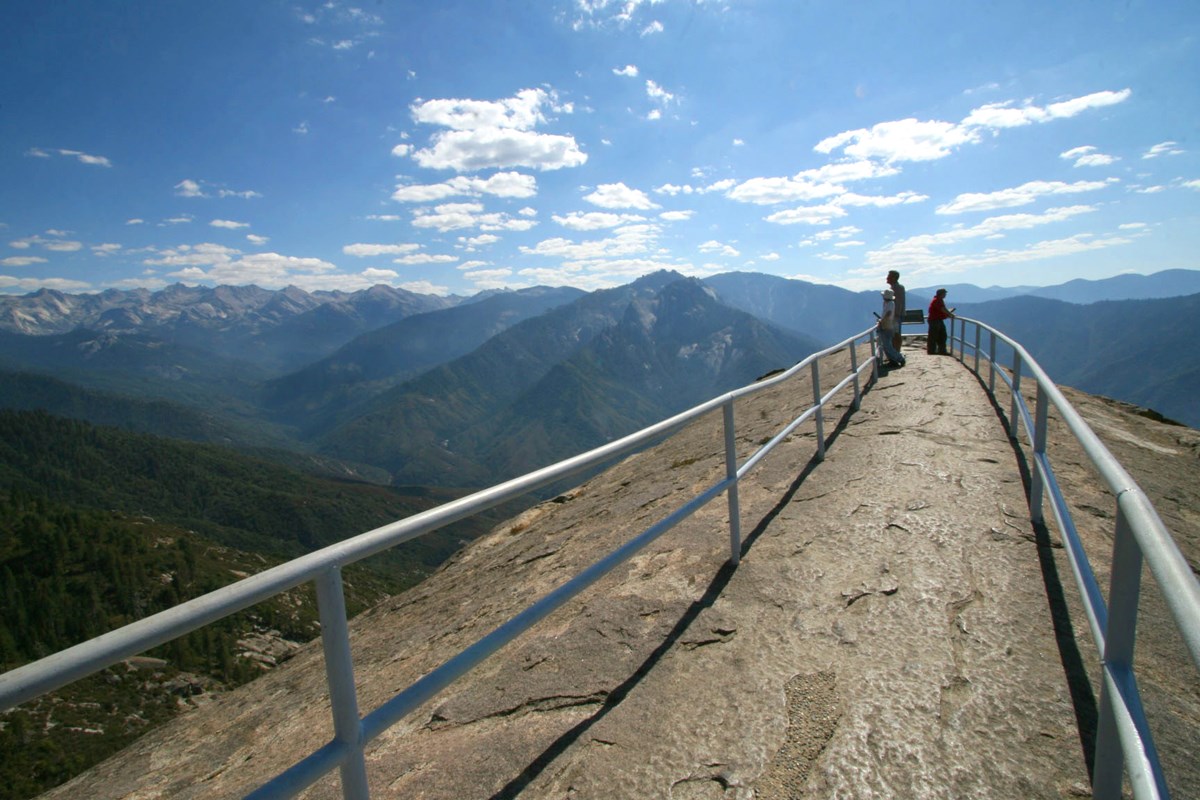 | Placard vehicles may drive the road even when it's closed to other private vehicles in summer, and wheelchair-accessible shuttles stop along it. The Moro Rock and Crescent Meadow lots have accessible spaces, and Crescent Meadow Picnic Area has accessible vault toilets. | Moro Rock is a stairway of over 350 steps, closed in winter. Crescent Meadow's accessible spaces are steeply sloped with no extended picnic tables, and the road closes for winter once snow makes it impassable. |
| Lodgepole | The visitor center has a power-operated door, barrier-free exhibits, audio description and assistive listening for films, and a motion-triggered soundscapes exhibit. Lodgepole Market has a roll-in shower with a bench and accessible summer laundry. | The visitor center is typically open May through mid-October, and the market's aisles are narrow. |
| Foothills Visitor Center and Hospital Rock | The visitor center has a power-assist door, tactile exhibits, a Braille park map to borrow, and accessible flush restrooms beside a native plant garden. Hospital Rock has three tactile exhibit panels and a paved path to an accessible flush toilet and an extended picnic table. | The low information desk has no knee clearance. Hospital Rock's two accessible spaces are on a significant slope, and the pictograph platform is up short, steep stairs, though you can see the pictograph from the ground with binoculars. |
| Tunnel Rock | Level, paved access to the base of the rock and the tunnel, with two accessible spaces on the Tunnel Rock side of the road. | The spaces are on a slight slope with no access aisles, and poison oak is common. |
| Crystal Cave and Mineral King | Crystal Cave tours can be taken in American Sign Language or with assistive listening devices. | The cave isn't wheelchair accessible: a steep, narrow 0.5-mile trail drops 300 feet with stairs, and the tour season is short, generally mid-May to late September. Mineral King Ranger Station is reachable only by stairs, and its campgrounds have no accessible sites yet. |
Restrooms, showers, parking, and picnics.
Accessible restrooms and parking are spread across developed areas. Check the specific lot, doorway and route to each facility.
Check the restroom route
Giant Forest Museum's nearby restrooms are not accessible. Use the accessible restrooms across the street. NPS access detailsVisitor-center access and restroom locations
NPS says accessible restrooms with sinks and flush toilets are at all major developed areas, and some picnic areas and campgrounds have accessible vault toilets with sinks. Accessible pay showers are at Lodgepole Market and at Cedar Grove Village in Kings Canyon, open during market hours. Every striped, paved lot in Sequoia and Kings Canyon has at least one accessible space, including van parking with access aisles. For a picnic, Pinewood Picnic Area, a mile north of Giant Forest Museum, has one extended table, accessible parking, raised grills, water fountains, and accessible vault toilets. Crescent Meadow has accessible vault toilets but no extended tables. Restaurants and markets are run by Delaware North and generally follow ADA guidelines (NPS limited mobility page).
Loaner wheelchairs, placards, shuttles, and passes.
Free manual wheelchair loans, temporary placards and accessible shuttles solve different parts of the journey. Visitor-center hours still matter.
Return a loaner the same day
Free manual wheelchairs are first-come, first-served at Giant Forest Museum, Lodgepole and Kings Canyon visitor centers. Return the chair to the same center by closing. NPS access detailsAsk about a temporary placard
Visitors with limited mobility who lack a DMV placard can request a free temporary placard at a visitor center. NPS requires no documentation for that placard. NPS access detailsEquipment, transportation and Access Pass details
Borrow a manual wheelchair free at Giant Forest Museum, Lodgepole Visitor Center, or Kings Canyon Visitor Center, first-come, first-served. You'll give your address and phone number, you can take it anywhere in the parks, and it goes back to the same visitor center by closing time that day (NPS accessibility page).
No placard? Ask at a visitor center for a free temporary accessible-parking placard. It's for people with limited mobility who don't have a DMV-issued placard, and NPS requires no documentation. You'll want one in summer, when the Big Trees Trail and General Sherman accessible lots are placard-only, and it lets you drive Moro Rock / Crescent Meadow Road when the road is closed to other private vehicles. Without a placard, ride the fare-free summer shuttle to the Sherman Tree Trail.
The free shuttles run in the Giant Forest and Lodgepole areas in summer and some holidays. All are wheelchair accessible, some buses kneel and others have lifts, and drivers announce every stop. When they're running, usually late May to early September, Moro Rock / Crescent Meadow Road closes to private vehicles on weekends and holidays from morning through late afternoon (NPS road information page). NPS says the separate gateway shuttle from Visalia and Three Rivers includes park entry in its fare and requires reservations. Check the operator for fares and seasonal dates (NPS mobility guidance).
The NPS Sequoia access page says U.S. citizens and permanent residents with permanent disabilities can get the free Access Pass at a park entrance station by signing a form confirming eligibility. It says medical documentation is not required. The pass does not cover Crystal Cave tickets; our Sequoia fees page has the details.
Seeing Sequoia from the car.
The Generals Highway climbs into the Giant Forest on winding roads. Vehicle length and winter chain requirements can affect the approach.
You can see a lot of Sequoia from the car. From the Foothills Visitor Center, the Generals Highway climbs about an hour to the Giant Forest and the General Sherman Tree. NPS advises against vehicles 22 feet or longer between Potwisha Campground and Giant Forest Museum, so a long van or RV should consider the Big Stump entrance on Highway 180. Most viewpoints and pullouts have no striped parking but sit on flat asphalt, and many views are visible without leaving your vehicle. In winter the Generals Highway closes at times for plowing, chains are often required, and passage to Kings Canyon may be unavailable. Our Sequoia road closures page has the details.
Hearing, vision and service animals
Captioned films, tactile exhibits and hearing assistance support visits beyond the trails. Arrange interpretation with the park before building a plan around it.
Choose your film format
Visitor-center films have captions, audio description and assistive listening. Ask at the information desk for a receiver. NPS access detailsUse tactile material
Giant Forest Museum and Foothills Visitor Center have tactile exhibits. Visitor centers lend a Braille park map, and Hospital Rock has tactile panels. NPS access detailsServices by location and service-animal rules
Every visitor center film has captioning, audio description, and assistive listening, with T-coil compatible receivers at the information desks, and amphitheater programs have assistive listening devices too. American Sign Language interpretation is free for most scheduled ranger programs if you ask at least two weeks ahead (NPS hearing page).
Visitor centers lend a Braille version of the park map. Giant Forest Museum and Foothills Visitor Center have tactile exhibits, Hospital Rock has tactile panels, and a tactile topographic model sits outside Mineral King Ranger Station. The NPS App has audio descriptions of outdoor exhibits (NPS vision page). The park's Accessibility Guide comes in standard and large print, six short films show accessible features through visitors' eyes, and the accessibility line is (559) 565-3341.
Wildlife and rattlesnake safety are on our Sequoia with kids page.
NPS welcomes trained service animals on trails and in facilities and programs. Emotional-support animals and animals still in training do not qualify. Keep the animal under control and leashed unless the leash interferes with its tasks. Store animal food in bear-proof containers; wildlife can react aggressively to dogs (NPS service-animal rules).
Wuksachi Lodge and accessible campsites.
Confirm Wuksachi room features directly and compare campsite slopes and restroom routes. Accessible-site labels do not remove every barrier.
Campsites, facilities and booking details
Wuksachi Lodge, in the Giant Forest area at 7,050 feet, has mobility and hearing accessible rooms with roll-in showers, widened doors, grab bars, raised toilet seats, lower peepholes, and visual alarms and notification devices. Beds are 24 to 29 inches high depending on room type. NPS gives no room count, so call (866) 807-3598, and note that chains may be required to reach the lodge in winter storms. For camping, accessible sites generally have an extended table, raised fire ring and grill, accessible parking, a level tent pad, a reachable food locker, and level paths, and an unoccupied first-come accessible site opens to anyone after 5 p.m. Lodgepole's sites 62 and 63 have a paved route to accessible restrooms, and the campground closes in phases from late September to early December. Potwisha, open all year, has sites 39 and 40, but the campground sits on a significant slope. NPS lists eight accessible sites at Dorst Creek and sites 20 and 40 at Buckeye Flat. Check official campground access and booking information for those campgrounds and South Fork, and Mineral King's Cold Springs and Atwell Mill have no accessible sites yet. Access Pass holders get 50 percent off standard camping fees. Booking is on our Sequoia camping page.
Pacing a big-tree day.
Group Giant Forest stops into one outing and leave room for breaks. Snow can cover paved routes well into spring.
Route planning, seasons and rest breaks
Put the General Sherman Tree first. The accessible lot, trail, restrooms, and benches are all in one place, and the Big Trees Trail and Giant Forest Museum are a short drive or shuttle ride away. Many ranger walks use short paved paths. Evening programs in campground amphitheaters have benches and assistive listening, and the Lodgepole amphitheater has a wide paved path, but the Dorst Creek amphitheater can't be reached by wheelchair.
Winter changes the plan. Storms can leave snow and ice as late as Memorial Day. The Big Trees Trail and the Grant Tree Trail in Kings Canyon stay open in winter but may not always be accessible, and NPS says the Grant Tree Trail has steep sections and isn't designated wheelchair accessible. Rangers lead free snowshoe walks from Giant Forest Museum and Kings Canyon Visitor Center, conditions permitting, with assistive snowshoes and balance poles (NPS limited mobility page). Check Giant Forest Museum's winter hours before relying on a loaner or staffed help. The best time to visit Sequoia page shows how busy each month gets.
Questions about Sequoia accessibility
Quick answers to the practical questions below.
Are mobility scooters allowed in Sequoia National Park?
NPS doesn't say. The park's accessibility pages give no rule for scooters or other power-driven mobility devices, so call the accessibility line at (559) 565-3341 before you bring one. Manual wheelchairs are free to borrow at Giant Forest Museum, Lodgepole Visitor Center, and Kings Canyon Visitor Center.
How we built this page.
An independent guide using official data. Not affiliated with or endorsed by the National Park Service.
- Official guidance
- NPS and the relevant operators. The linked official pages support the access, facilities and rules described here. Confirm details before traveling.
- Schedules and conditions
- Planning patterns, not live status. Seasonal information describes the normal pattern or explicitly dated source schedule. Current conditions are handled separately. The official source is the place to confirm today’s access.
Topic sources and data details
The General Sherman and Big Trees trails, parking by season, Beetle Rock, Moro Rock / Crescent Meadow Road placard access, Crystal Cave, Giant Forest Museum, Lodgepole, picnic areas, showers, laundry, amphitheaters, and Wuksachi Lodge come from the NPS Giant Forest and Lodgepole page; Hospital Rock, Tunnel Rock, Foothills Visitor Center, Potwisha, Buckeye Flat, and South Fork from the NPS Foothills page; the Grant Tree Trail from the NPS Grant Grove page.
Placards, wheelchair loans, shuttles, the Access Pass, the Accessibility Guide, and films come from the NPS accessibility page; summer placard-only lots, parking, lodge room features, campsite features, restrooms, showers, visitor centers, ranger programs, winter trails, snowshoes, and viewpoints from the NPS limited mobility page; captions and ASL from the NPS hearing page; Braille and tactile exhibits from the NPS vision page.
Moro Rock's steps and winter closure come from the NPS Moro Rock page; cave tour planning from the NPS Crystal Cave page; the weekend road closure, vehicle-length advisory, and winter highway notes from the NPS road information page and NPS winter activities page; Wuksachi's elevation from the NPS lodging page; campground access, Lodgepole's season, Potwisha, Mineral King, and the camping discount from the NPS campgrounds API and NPS campgrounds page; the Access Pass from the NPS fees page; gateway shuttle planning from the Sequoia Shuttle.
The Dorst Creek count adds the site numbers NPS lists. The order of the day is our own suggestion.
Operational source check: September 11, 2026. Design and emphasized source review: 2026-10-23. A design review does not refresh every underlying record.