Per-month · October

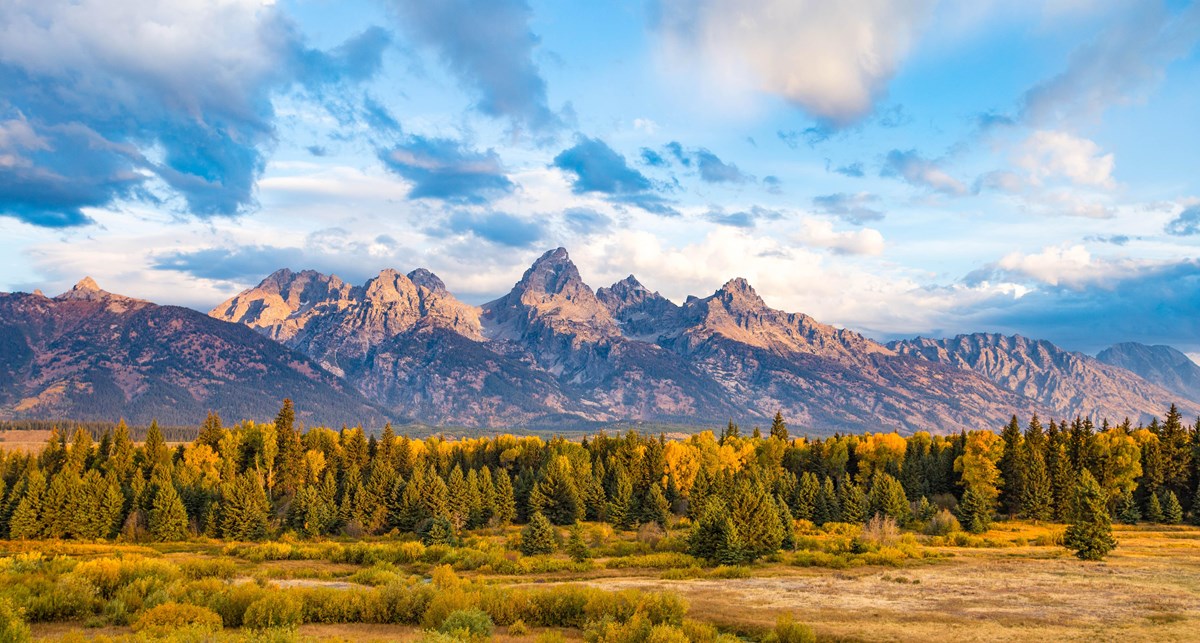
Grand Teton in October.

October is the broadest-appeal fall month at Grand Teton.

By Nicholas Major · Last updated

October is Grand Teton's strongest fall shoulder month. The five-year mean is about 248,000 recreation visits — about 34% of July's peak — and the within-month curve has two distinct halves. Every park road remains open through the first three weeks; the inner Teton Park Road closes to wheeled vehicles November 1 per NPS, and Moose-Wilson Road closes the same day. NOAA normals at the Moran 5WNW station record an October high near 51°F with overnight lows near 25°F and a snowfall normal of 6.5 inches — the first sustained winter storm cycles begin to land. The elk rut peaks through the first three weeks; aspen color holds at valley elevation through the front half before drop. The Jenny Lake Boating shuttle ends September 30 — Jenny Lake's west-shore hikes return to the full hiking loop. For visitors who want fall color, the elk rut, and the last drivable inner roads before winter, October is the strongest non-summer window.

Crowd snapshot.

October runs about 248,000 recreation visits in the five-year mean — about 34% of July's peak. The first two weeks remain shoulder-busy as fall-color travelers arrive and the elk rut overlaps with the aspen turn. The last 10 days drop sharply once the inner Teton Park Road and Moose-Wilson Road close November 1; in-park lodges begin closing through the month, and Jackson lodging eases through the final week. The Jenny Lake Boating shuttle ended September 30. Jenny Lake, String Lake, and Taggart Lake parking lots open up to mid-morning availability through the back half.

FieldValue
October recreation visits (5-yr mean)247,505
Share of July's peak34%
Crowd bandmoderate
Park's busiest month (5-yr mean)July
Park's quietest month (5-yr mean)December

Weather snapshot.

The Moran 5WNW NOAA station records an October high near 51.0°F and a low near 24.7°F. The monthly snowfall normal of 6.5 inches marks the first significant winter storm activity at the valley station; early-October snowstorms occasionally produce 1-2 feet at the high country in a single event. Daytime sun remains strong on clear days, and lower trails stay accessible through mid-month, but shaded north-aspect terrain and the inner park roads accumulate snow. Late-month overnight lows land in the upper teens at the valley floor; the high country sees materially harder freezes. The first sustained inversion-driven valley fog can settle over the Snake River bottomlands in calm mornings.

FieldValue
Average high (°F)51.0
Average low (°F)24.7
Precipitation (inches)1.92
Snowfall (inches)6.5
Weather bandcold
StationMoran 5WNW HCN, WY at 6,805 ft

Access snapshot.

Every park road remains open through the first three weeks of October. Inner Teton Park Road closes to wheeled vehicles November 1; Moose-Wilson Road closes the same day — confirm exact closure timing on the NPS Grand Teton roads page. The US-89 / US-191 / US-26 through-corridor stays plowed and open year-round. In-park lodges close through the month — confirm specific properties via Grand Teton Lodge Company and Signal Mountain Lodge. Jenny Lake Boating ended September 30. The elk rut remains in full peak — keep 100 yards from bull elk per the NPS safety page. Bears remain actively feeding pre-denning; bear spray applies on every hike.

FieldValue
October access score (0-100)90
Year-round routeUS-89 / US-191 / US-26 through-corridor along the east side of the park (inner Teton Park Road closed November 1 through April 30; Moose-Wilson Road closed November 1 until mid-May)
Verify current road and conditions statusOfficial NPS Grand Teton roads page

Seasonal events.

October is the headline fall-color and elk-rut month. Subalpine aspens peak gold in the first week along the Snake River corridor, Schwabacher Landing, and Oxbow Bend; the cottonwoods follow in the second week. The elk rut peaks through the first three weeks of October — bull elk bugling along the willow flats and the sage benches at dawn and dusk is at its year's reliable peak (NPS Grand Teton wildlife). Mule-deer rut peaks in the last 10 days. Bears continue feeding on whitebark pine seeds, huckleberry, and carrion in the run-up to denning; grizzly sightings remain elevated through October. Wintering raptors begin holding territory along the river corridors. Late-month dark-sky conditions are excellent during new-moon weeks. The last sandhill cranes depart by month-end.

Audience verdict.

October is the broadest-appeal fall month at Grand Teton. It serves photographers (aspen gold, the elk rut at dawn, the last drivable inner park roads), retirees and shoulder-season travelers, families with flexible calendars, and any visitor wanting cooler weather without the deep-winter access limits yet. The single biggest planning question is whether the trip lands inside or outside the November 1 inner-road closure — anchor on the NPS roads page. RV travelers gain availability across in-park campgrounds in the last 10 days but should expect cold nights. Visitors who want quieter conditions and don't need the inner roads should target the post-November-1 stretch when the through-corridor becomes the only option.

Methodology

Monthly recreation visits come from the official NPS Visitor Use Statistics Data Package, 2025 on NPS IRMA Stats; the statistic shown is Recreation Visits, the 5-year mean across 1979-2025. Climate normals come from NOAA NCEI's 1991-2020 U.S. Climate Normals at Moran 5WNW HCN, WY (station USC00486440, 6,805 ft elevation). The access score weights named park roads by route importance for typical wheeled-vehicle openings that month. Year-variable specifics — exact inner Teton Park Road open/close dates, Moose-Wilson Road open/close dates, the Jenny Lake Boating shuttle season, in-park lodge operating windows — drift year to year and are hedged in the editorial above; confirm current dates on the official NPS Grand Teton page before booking. Independent site, not affiliated with the National Park Service.

Independence

Independent site. Not affiliated with or endorsed by the National Park Service. Data comes from the official NPS Visitor Use Statistics Data Package, 2025; editorial analysis is ours. The NPS Arrowhead and other NPS marks are not used.

Last updated · 2026-05-20