Per-month · March

Grand Teton in March.

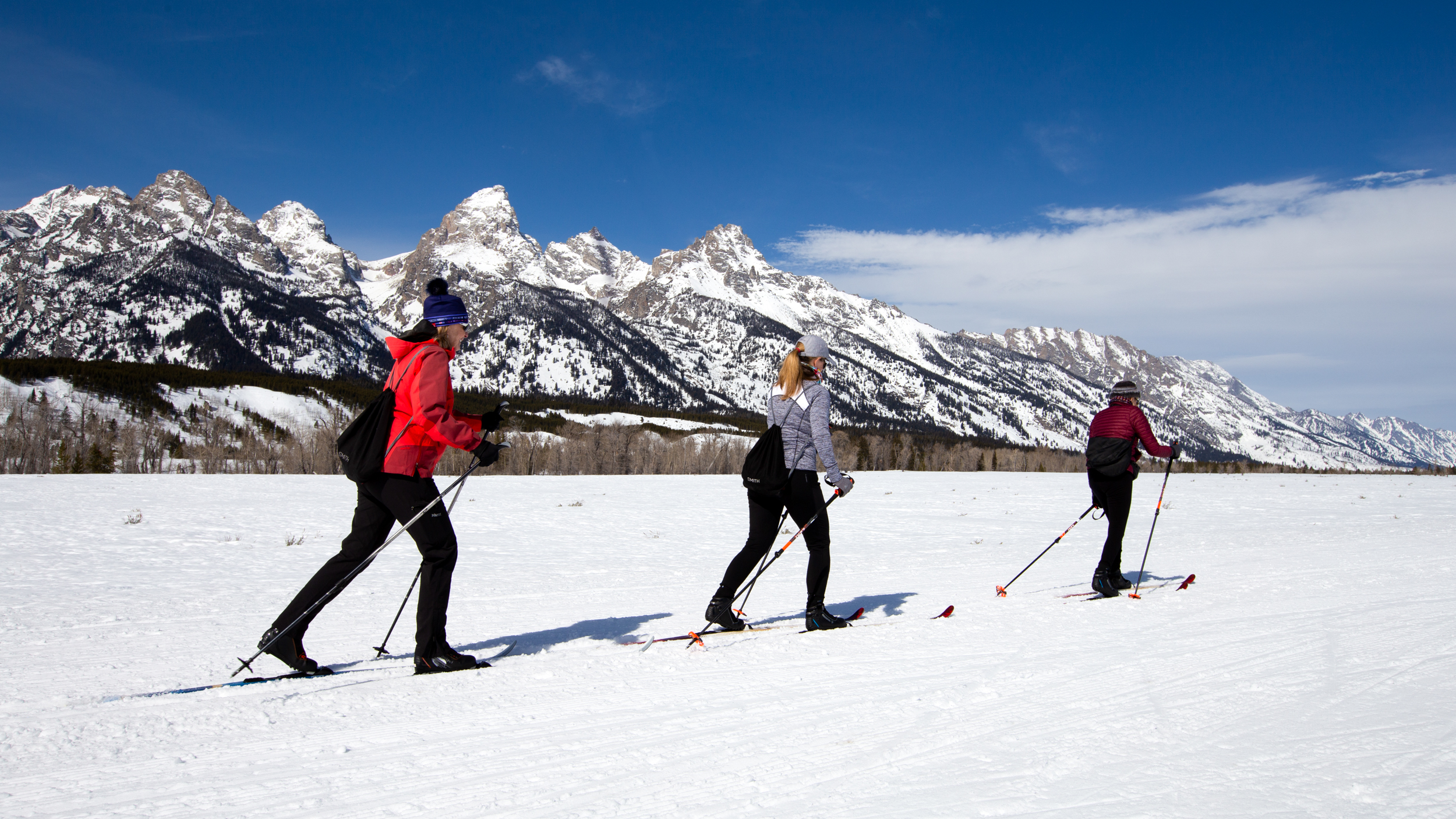
March suits visitors who want winter-recreation conditions with slightly longer light and the option of catching early wildlife activity: cross-country skiers and snowshoers on the Teton Park Road grooming window before it ends, photographers chasing the last of the frost-and-low-angle compositions, and Jackson-anchored day-trippers.

By Nicholas Major · Last updated

March is a transition month at Grand Teton. Five-year visits climb slightly to about 65,000 — still far below summer numbers, but the first incremental lift off the deep-winter floor as regional spring-break travel begins. Interior park routes hold their off-season status until May 1, with Moose-Wilson still unavailable to cars until mid-spring. The eastern federal highway corridor remains the lone plowed visitor route. Cooperative observer values at Moran 5WNW put the March high near 39°F, lows around 12°F, and snowfall at 22.0 inches. Grooming on the inner road typically wraps by mid-month, and the cross-country skiing window begins to wind down as freeze-thaw cycles set in. For visitors trading deep snowpack on the range for slightly warmer days and longer light, March is the strongest pre-spring window — but operationally, it remains a winter trip.

Crowd snapshot.

March runs about 65,000 recreation visits in the five-year mean — roughly 9% of July's peak and the first month with a measurable lift off the deep-winter baseline. Regional spring-break traffic from Front Range and Mountain West school districts concentrates traffic into the middle two weeks, with Jackson lodging tightening on weekends but remaining broadly available. Weekday traffic on the through-corridor stays genuinely light. The Craig Thomas Discovery and Visitor Center runs winter cadence early-month and bumps to spring cadence in the back half. The ranger-led snowshoe-hike program continues through the month.

FieldValue
March recreation visits (5-yr mean)64,755
Share of July's peak9%
Crowd bandlowest
Park's busiest month (5-yr mean)July
Park's quietest month (5-yr mean)December

Weather snapshot.

The Moran 5WNW NOAA station records a March high near 38.6°F and a low near 11.8°F. The monthly snowfall normal of 22.0 inches keeps the valley solidly in winter, and storm cycles can still deliver a foot or more in a single event on the range. Daytime sun is strong enough that south-facing sage benches and lower trails melt out between storms, but the snow-covered Teton Park Road and shaded forest sections stay wintery through most of the month. Freeze-thaw nights set in late-month — solid morning crust, soft afternoon snowpack — which signals the wind-down of reliable ski-and-snowshoe conditions on the groomed surface.

FieldValue
Average high (°F)38.6
Average low (°F)11.8
Precipitation (inches)2.34
Snowfall (inches)22.0
Weather bandcold
StationMoran 5WNW HCN, WY at 6,805 ft

Access snapshot.

Inner Teton Park Road stays closed to cars through April 30; Moose-Wilson Road remains closed until mid-May — confirm on the NPS Grand Teton roads page. The US-89 / US-191 / US-26 through-corridor stays plowed. Teton Park Road grooming for non-motorized use typically wraps up by mid-March; ranger-led snowshoe hikes continue per the NPS Grand Teton winter page. In-park lodges and most in-park campgrounds remain closed; Jackson is the practical lodging base. NPS continues to warn that bears (both black and grizzly) roam through most winter months — early-spring den emergence is possible by late March, so bear spray applies on any backcountry travel per the NPS Grand Teton conditions page.

FieldValue
March access score (0-100)55
Year-round routeUS-89 / US-191 / US-26 through-corridor along the east side of the park (inner Teton Park Road closed November 1 through April 30; Moose-Wilson Road closed November 1 until mid-May)
Verify current road and conditions statusOfficial NPS Grand Teton roads page

Seasonal events.

March is the wind-down of winter recreation and the leading edge of early-spring wildlife activity. Cross-country skiing and snowshoeing remain workable through the first three weeks before the snowpack on the groomed Teton Park Road softens past reliable. Bull elk drop their antlers through the month; shed-antler hunting is heavily regulated and prohibited inside the park boundary. The first early-spring grizzly den emergence is possible in the last week — NPS bear safety guidance applies year-round and especially as the snowpack retreats. Bald eagles begin nest-building along the Snake and Buffalo Fork drainages. Bison move slightly off the wind-scoured benches as forage becomes accessible. Late-month sun gain is the most rapid of any month.

Audience verdict.

March suits visitors who want winter-recreation conditions with slightly longer light and the option of catching early wildlife activity: cross-country skiers and snowshoers on the Teton Park Road grooming window before it ends, photographers chasing the last of the frost-and-low-angle compositions, and Jackson-anchored day-trippers. It is not a month for any high-country travel — the range is still buried, avalanche danger remains real on any non-trail terrain, and the inner park roads and Moose-Wilson stay closed. Families on school-locked spring-break calendars can use the ranger-led snowshoe-hike program through the front half; the back half loses reliable snow on the groomed surface.

Methodology

Monthly recreation visits come from the official NPS Visitor Use Statistics Data Package, 2025 on NPS IRMA Stats; the statistic shown is Recreation Visits, the 5-year mean across 1979-2025. Climate normals come from NOAA NCEI's 1991-2020 U.S. Climate Normals at Moran 5WNW HCN, WY (station USC00486440, 6,805 ft elevation). The access score weights named park roads by route importance for typical wheeled-vehicle openings that month. Year-variable specifics — exact inner Teton Park Road open/close dates, Moose-Wilson Road open/close dates, the Jenny Lake Boating shuttle season, in-park lodge operating windows — drift year to year and are hedged in the editorial above; confirm current dates on the official NPS Grand Teton page before booking. Independent site, not affiliated with the National Park Service.

Independence

Independent site. Not affiliated with or endorsed by the National Park Service. Data comes from the official NPS Visitor Use Statistics Data Package, 2025; editorial analysis is ours. The NPS Arrowhead and other NPS marks are not used.

Last updated · 2026-05-20